 creation PLUS
This reward is provided only in Korean,
Versions in other languages, such as English, are not available.
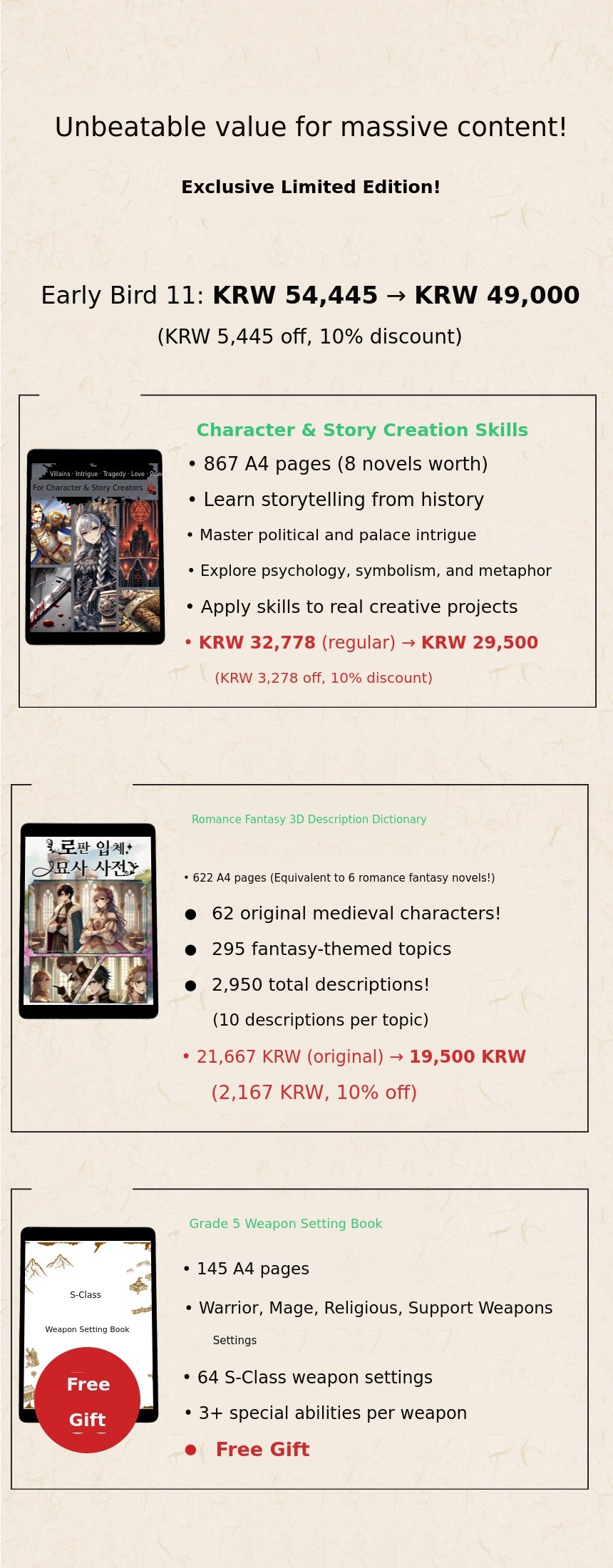
1) Character & Story Creation Techniques


[Table of Contents]
Chapter 1, Villainess Edition: Perfect Guide to Villainess Characters in Romance Fantasy
1) The bloodthirsty monster born from a ruthless marriage: Mary I
2) The empress who wielded power in place of her intellectually disabled husband, kidnapped and killed beautiful boys: Jia Nanfeng
3) The extravagant woman who built a garden with navy funds and made China a semi-colony of Japan: Empress Dowager Cixi
4) The empress who killed all her siblings for her husband: Lucrezia Borgia
5) The empress who became obsessed with a younger man and led him to ruin: Theodora
6) The murderer blinded by love for her husband: Medea
7) The woman who took an irreversible path out of jealousy: Phaedra
Chapter 2, Women’s World Edition: Creating Stories Where Women Rule the World
1) The empress who fought desperately with a mad husband: Margaret of Anjou
2) The grandmother who killed her cross-dressing gay grandson: Julia Maesa
3) The empress who killed her own son: Wu Zetian
4) The Empress Who Conspired with Her Daughter to Kill Her Husband: Empress Wei
5) The Princess of a Small German Principality Who Tried to Become Russian to the Core: Empress Catherine
Chapter 3, Knights: Setting Up the Legendary Order of Knights
1) The Sword-Wielding Monk Who Germanized Prussia: Teutonic Order
2) Medical Volunteers Reborn as Warrior Knights Fighting Muslim Pirates: Knights Hospitaller
3) Holy Knights for God, Secularized into a Giant Financial Institution: Knights Templar
4) From Guardians of the Holy Land to Leaders of Massacres: Teutonic Knights
5) Wielding the Sword for Salvation Through Medicine and Faith: Knights of St. John
Chapter 4, Mercenaries: Creating the Epic of the Continent's Strongest Mercenaries
1) From Mercenary to the Greatest Duke of the Duchy of Milan: Francesco I Sforza
2) The Mercenary Leader Who Destroyed the Western Roman Empire and Changed History: Odoacer
3) The Versatile Mercenary with Valor, Insight, and Profit: Albrecht von Wallenstein
4) The Legendary Cavalry Commander and His Final Loyalty: Johann von Werth
5) The Golden General Who Changed the Fate of Europe: Eugene of Savoy
Chapter 5, Conspiracies: Designing a web of intrigue and schemes
1) Becoming a wise ruler through plots and schemes: Philip II
2) The pope's illegitimate child, a role model for historical monarchs: Cesare Borgia
3) Vulgar and shallow divide-and-rule politics! In reality, the seed of a ruthless massacre: The Rwandan Genocide
4) A political genius who exemplified compliance and betrayal: Septimius Severus
5) An ordinary man purges geniuses and ascends to power: Stalin
6) A traitor who forged a will to avenge his fallen homeland: Zhao Gao
Chapter 6, Palace Intrigue Edition: Creating stories of suffocating power and political struggles
1) The end of a passionate man! Double suicide after failing to become emperor: Antonius
2) The outsider conqueror suspected of incestuous marriage: William I
3) The nobles' game of chicken: The Wars of the Roses
4) Factional strife and the foundation of parliamentary democracy: Simon de Montfort
5) Absolute monarchy that suppressed the rebellion of nobles and citizens: The Fronde
6) The role model for Sejo, who killed Danjong and became king: Yongle Emperor
7) The parricidal emperor who threatened his father and killed his brothers, yet became the greatest ruler: Emperor Taizong of Tang
Chapter 7, Religion Edition: The name of religion(Light)and Darkness(Dark) Composition
1) The emperor who repented barefoot for three days on snow to apologize to the Pope: Henry IV
2) The birth of international law, caused by religious conflict. The first world war, the Thirty Years' War.
3) BBC's selection of the greatest and worst Britons: Henry II and Thomas Becket.
4) The charismatic monarch who kidnapped the Pope and slapped his face: Philip IV.
5) Religious conflict that led to a massacre: The Huguenot Wars.
6) Is the image of Jesus nothing but a stone? The ban on icon worship.
7) Those who sought pure spirituality but were branded as heretics: The tragedy of the Cathars.
8) The seeds of rebellion that toppled a dynasty: The White Lotus Rebellion.
Chapter 8, Revolution Section: Setting the struggles and ideologies of great revolutionaries.
1) The essence and classic example of media manipulation: The French Revolution.
2) The result of an almost obsessive sense of justice: Massacre by Robespierre.
3) The king who wanted to become an absolute monarch and the parliament that tried to stop him!: The Puritan Revolution and the Glorious Revolution.
4) Firmly upholding the ideals of the French Revolution: The Haitian Revolution of Black Slaves.
5) Driven to the edge and starting a revolution: Luther's Reformation.
[Notion Preview]
[Main Content Preview]
*History is written like a short story to make it easy to understand!
1) The bloody monster born from a ruthless marriage: Mary I.
16th century England. At the heart of the Tudor dynasty, a woman sat quietly. Her red hair had lost its shine under the weight of the crown. Her eyes glimmered coldly, as if stained with blood. Her name was Mary I. But people called her 'Bloody Mary.'
【A Ruthless Birth】
Mary's birth should have been a blessed moment, but a shadow of misfortune soon fell over her. Her father, Henry VIII, sacrificed religion and family for the throne. To strengthen royal power and solve the succession issue, he ended his marriage with Queen Catherine. At the same time, he demoted Mary's status and made her illegitimate. This event left a deep scar on Mary. It was from this time that distrust and hatred began to grow.
"Father, why did you abandon Mother?"
When young Mary pleaded with tears, Henry answered coldly.
"The royal family cannot be weak. You must understand that."
At that moment, Mary made a decision. She would never be weak. To become strong, Mary relied on her Catholic faith and nurtured hatred in her heart.
【The Throne and the Path of Blood】
Time passed, Henry VIII died, and England entered an era of turmoil. Mary's half-brother, Edward VI, strongly pushed Protestant policies, but died young from illness. Jane Grey, who succeeded him, was caught in a power struggle and was deposed after just nine days.
At last, Mary ascended the throne. Carrying the wounds and distrust of her childhood, she came to rule the kingdom. She chose iron-fisted rule over peace.
Mary had only one goal: to return England to the embrace of Roman Catholicism. To achieve this, she held religious trials, persecuted Protestants, and executed those deemed heretics. Her religious fervor made her even more ruthless.
"Execute all traitors. It is God's will!"
Mary's voice was cold and strong.
Under her command, the screams of burning Protestants echoed through the city from the stake. In the flames, Mary's name became a symbol of fear and terror. People called her 'Bloody Mary.' To maintain her authority as queen, she instilled fear rather than trust among the people.
【Political Intrigue and Marriage】
Mary married Philip II of Spain to strengthen the monarchy and solidify the Roman Catholic faith. However, this marriage was nothing more than a matter of political calculation and duty. Philip prioritized power and ambition over affection in his relationship with Mary. Mary felt lonely. Within the kingdom, people said that Philip married Mary as part of a plot to bring England under Spanish influence.
“Philip, can you not stay by my side?”
When Mary asked desperately, Philip replied coldly.
“My duty is to the empire, Mary. Please understand that.”
In the end, Mary had to fight alone, receiving comfort from no one, neither in political diplomacy nor in her private life.
【Sorrow and Regret】
The loneliness of power tore Mary's heart apart. As time passed, Mary's health deteriorated, and the people's discontent grew. Amidst countless accusations and alienation, Mary doubted whether her choices had been right. She reflected on whether the justice and faith she believed in were truly the right path, sinking into regret and sorrow.
“Mother, please forgive me. I... I do not know if my choices were right.”
Mary muttered alone in an empty room. Tears welled up in her eyes. But those tears could not wash away her bloodstained reputation.
【Conclusion】
Mary I held firmly to the throne until her last day, but the price was unbearably heavy. In 1558, she died after a long illness. In her final moments, only a few loyal subjects remained by her side. The support of the people had long since vanished, and she was remembered only as a 'bloody monster.'
After her death, her younger sister Elizabeth I ascended the throne. England entered a new golden age. Mary's death marked a new beginning, but her legacy remained a deep scar in history.
“I hope the path I chose was right... But that path led me to loneliness...”
Mary's last breath scattered into the air.
※ For creative use
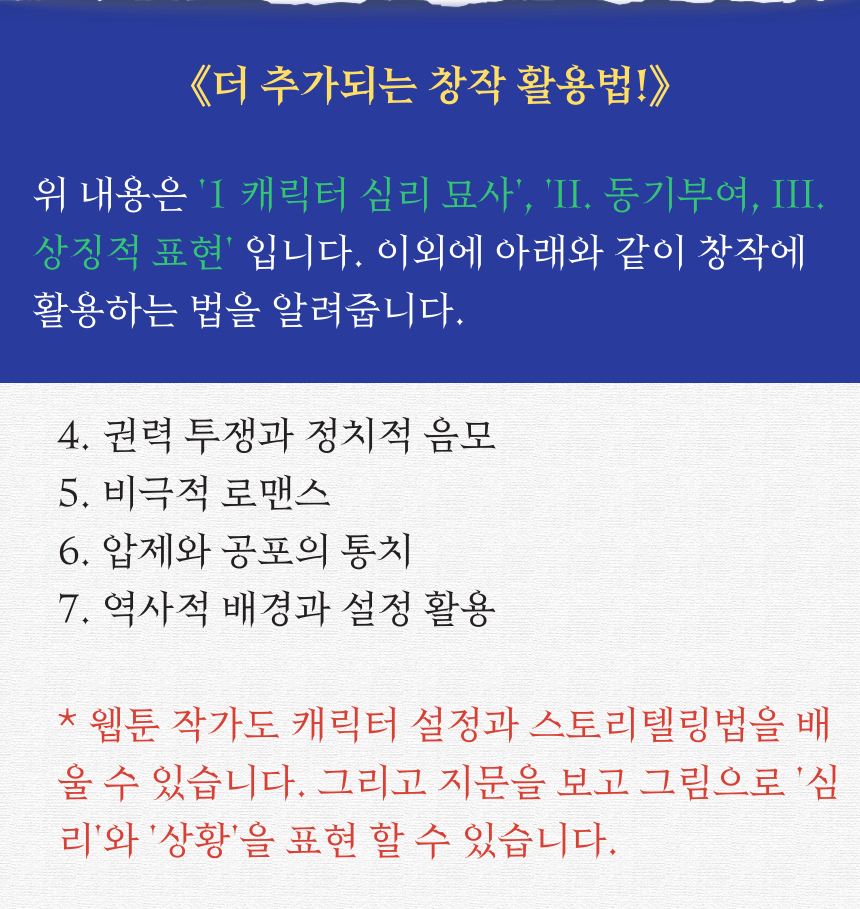
1. Character psychological description
■ Inner conflict
Utilize the parts that depict Mary I's psychological pain and anxiety to portray the character's inner conflict more deeply. In order to make readers empathize with the protagonist's emotions, express the character's wounds, decisions, and regrets in detail. In particular, it is more effective to convey psychology through changes in actions or facial expressions rather than direct emotional narration. For example, inner conflict can be shown through specific actions such as staring at oneself in the mirror for a long time or tearing up a childhood portrait.
▶ Example of Applying Inner Conflict
【Moment of Wound】
The princess sat in front of the mirror. She was wearing a newly made ceremonial robe, but her hands kept fiddling with the old necklace she had worn as a child. When a maid approached to remove the necklace, the princess's hand flinched unconsciously. 'Leave it.' Her voice was cold, but the fingertips holding the necklace trembled slightly.
[Moment of Decision]
She raised her head to face her brother's portrait. The brother who had now become her enemy. The queen's fingertips touched the seal. On the document, her brother's handwritten confession of treason and the order for his execution were written side by side. She hesitated for a moment. Outwardly, she appeared calm, but the hand clutching her sleeve trembled white. The moment the bright red seal was stamped, the last remaining family member's neck fell coldly onto the guillotine.
【Moment of Regret】
Every night at the same time, the queen walked through the garden. Her subjects thought she enjoyed her strolls. But no one knew that she always stopped at the same spot, gazing in the direction of the execution ground. Only her long shadow stretched beneath the moonlight.
■ Motivation
Explain why the character had no choice but to change in this way. If power and revenge are the motivations, show what past experiences made her so obsessed with them. In this way, create dramatic twists by showing the character's growth and transformation. What is important here is to show the process of change step by step. Rather than a sudden change, it is more convincing to structure it so that small incidents accumulate and explode at a decisive moment. Also, if you place a scene where the character recalls past wounds right before an important decision in the present, readers can naturally understand the character's actions.
▶ Example of Applying Motivation
【Stage 1: Beginning of the Wound】
She was twelve years old. The young princess watched her mother being deposed in a solemn ceremony. The emperor appointed a new queen in less than a week. The princess knelt on the marble floor and bowed her head to the queen. It was the count's maid who had once been her nanny."You are a good child." The king said.
The emperor smiled and nodded. But the princess was filled with pain. Red nail marks were deeply imprinted on her palm.
【Stage 2: Inner Change】
With each passing year, the princess's smile became perfect. At the banquet, she was the most dazzling presence.But no one knew. That every night in front of the mirror,she practiced the same smile hundreds of times, Memorizing etiquette and recording the weaknesses of others. Her diary gradually filled with the secrets of the powerful.
【Step 3: The First Attempt】
"The maid suddenly died of illness?" The princess put on a look of pity. It was nothing but an act. She no longer trusted the maid. When she first handed over the poisoned tea, her hands trembled, but now there was no trembling, no guilt.
【Step 4: The Turning Point of Fate】
'Your Majesty, the princess is plotting treason.' The princess, who was only fifteen, was falsely accused and imprisoned in an underground cell. Enduring a month of biting cold, hunger, and loneliness that seeped into her bones, she realized: if she did not gain power, she too would one day be abandoned like her mother.
【Step 5: The Design of Revenge】
It was a reunion after ten years. The count who had framed the princess bowed to the emperor at the banquet. "I wish to take the princess as my son's lawful wife." For a moment, the princess's eyes flashed coldly. Yet a graceful smile played on her lips. At last, the opportunity had come. All she had to do was carry out her plan.
- By showing specific events and the resulting psychological changes at each stage, you can naturally depict how the character transforms into a villainess.
2. Symbolic Expression
■ Symbolism and Metaphor
Descriptions like Mary's 'blood-red eyes' visually symbolize a character's emotions or situation. Such depictions are used to intuitively convey a character's personality or atmosphere to the reader. It is effective to develop a single symbol throughout the entire story. For example, you can hint at a character's transformation through the process of once-clear eyes gradually turning blood-red, or symbolically show the story's progression through changes in the seasons. You can also express the weight of power or responsibility through props like the weight of a crown or a particular piece of jewelry.
▶ Applying Symbolism and Metaphor
1) Hinting at Character Change Through Changes in the Eyes
- First appearance: The princess had clear eyes. In those eyes was an innocence that knew nothing of the darkness of the world.
- After the first betrayal: Standing before the mirror, her gaze had changed. Just as a dark shadow seeps beneath a calm surface, darkness began to settle in her eyes.
- After seizing power: No one could meet her gaze for long. An unfathomable darkness had taken root there, and at times a cold light flickered through.
- Final moment: The last spark ignited in her eyes. It blazed red and intense like the torches of the execution ground, then faded away in an instant.
2) Narrative Hints Through the Change of Seasons
- Spring: Warm spring sunlight poured through the high windows of the cathedral. The newly crowned empress's golden crown shone brilliantly, and the long hem of her robe bloomed white like spring flowers.
- Summer: Her power reached its peak, like the summer sun. In every city of the empire, there was no one who defied her command.
- Autumn: As the cold wind blew, the court gradually grew colder. Laughter in the banquet hall faded, and the loyal subjects by her side left the palace one by one.
- Winter: In the depths of winter, the cathedral bells rang. When the sound ceased, the empress's funeral procession departed the grand cathedral. All she left behind was a chilling silence.
3) Symbols of Power and Responsibility Through Props
- Crown: The crown she wore for the first time was heavier than she expected. As time passed, its weight only grew, and eventually, the crown began to press down on her very soul.
- Document: She hesitated for a long time in front of the document ordering the execution of a criminal. However, as time went by, her hand grew more indifferent as she pressed the red wax seal, and her heart became as cold as her unfeeling hand.
- Mirror: Every night, she stood before the mirror. At first, it was to admire her own beauty. Later, she gazed in fear at how she was changing. After eliminating her rivals, only cold, unfamiliar eyes shining back at her remained.
These symbols are repeated and gradually change throughout the story, naturally revealing the character's inner transformation and the flow of the narrative.
■ Symbolism of Fire and Blood
The burning pyre and a reputation stained with blood are scenes that can symbolically represent the protagonist's cruelty and its consequences. When using such symbols, it is best to incorporate not only visual images but also various sensory elements. Adding the heat of the flames, the smell of ash, and the scent of blood can make the scene more vivid. Also, by having these symbols repeatedly appear as nightmares or hallucinations, psychological pain can be effectively conveyed. In particular, capturing moments when symbolic images overlap with reality is effective in simultaneously showing the character's inner world and external circumstances.
▶ Applying Flames and Blood
Memories of the Execution Ground
On the first day she ordered an execution, she couldn't even glance in the direction of the rising flames. The screams she heard haunted her that night. As the executions continued, the smell of fire and ash became familiar. After a month, she looked directly at the execution ground for the first time. After a year, she raised her glass while watching the soaring flames.
Recurring Nightmares
Every night, red mist rose in her dreams. At first, faint shadows passed by, and as the night deepened, the figures became clearer. In the eerie mist, she discovered another version of herself. She was commanding executions from the throne, shrouded in red mist. When she awoke, her body was drenched in cold sweat.
The Boundary Between Reality and Fantasy
It was the day of the court banquet. Wine filled the glasses, and torches lit up the grand hall. Reality began to distort before her eyes. The red wine in her glass looked like blood, and the torches appeared as the flames of the execution ground. The laughter of the nobles sounded like the screams of criminals in the fire. To her, even the banquet hall was now just an extension of the execution ground.
※ Glossary
- Ruff Collar: A collar made by pleating linen or lace into an S-shape, creating a high, rounded form. It was a clothing ornament symbolizing the wealth and authority of the nobility at the time.
※ Reference
- English Prayer: Henry VIII and his successor Elizabeth I greatly improved access to the scriptures by having the Church of England's Bible translated into English. The practice of scribes writing prayers in English was one of the results of the Reformation.
*In addition, there are many more creative applications. There are also references like the above to help easily understand word meanings and history.
2) Romance Fantasy Three-Dimensional Description Dictionary

Not only does it strengthen your writing skills, but it is also a time-saving description dictionary for authors pressed for serialization!
Volume Composition
- The most frequently appearing in romance fantasy and fantasy,62 Medieval Characters!
- Specialized for romance fantasy and fantasy,Composed of 295 table of contents!
- Number of descriptions only2,950 descriptions!(10 descriptions per subtitle)
- An overwhelming amount for the price!622 pages of A4!(Equivalent to 3 romance fantasy books!)
Description composition
- Frequently appearing in romance fantasy and fantasySituation descriptions
- Medieval, RenaissanceClothing descriptions
- By personality typeCharacter appearance descriptions
- Space (location) andAtmosphere descriptions!
- Various professionsWork process descriptions!
Focus from now on!
<Romance Fantasy Three-Dimensional Description Dictionary>!
Explains how it is differentiated from other dictionaries!
1. Descriptions by situation
We have selected 62 medieval characters that appear most frequently in romance fantasy and fantasy genres.
So, each of these characters must have situations that often appear as clichés, right?
For example'King' would often be involved in palace intrigue,'Elimination of political enemies' is one such situation.
Then, the table of contents for the king is organized as follows.
1) King
Elimination of political enemies
① Space & atmosphere
② Appearance
③ Attire
After creating a situation called elimination of political enemies, we proceed by dividing it into descriptions ①, ②, and ③.
First, let's look at the description for elimination of political enemies, '① Space & atmosphere'!
The king's study
The king's study was filled with parchments scattered in disarray. Thick velvet curtains blocked the light from outside, leaving the room dim. Only the flickering fire in the fireplace cast red shadows. On the desk lay the head of a political enemy. A pale face, a half-open mouth, and a trail of blood that stained the surrounding parchments.
Palace banquet hall
Under the grand chandelier of the palace banquet hall, laughter and music mingled together. Suddenly, a sharp scream rang out, and the king's sword flashed, piercing the heart of silence. Glasses shattered with a crash, and the festive heat instantly froze. In the sudden stillness, only the king's cold gaze shone.
Cathedral
A cathedral bathed in brilliant colors from stained glass. As the sound of prayers echoed softly, the king stood before the altar and drew his long sword. The duke, who had plotted rebellion, begged for mercy in terror, but the sharp blade sliced through the air and struck his chest. Crimson blood splattered across the sacred altar.
Dark Underground Prison
In the underground prison shrouded in darkness, the stench of death was overwhelming. The clinking of rusty chains, the sound of water dripping down damp walls, and the groans of the dying blended into a sinister melody. The king's blade gleamed coldly, and the sword pierced the traitor's neck.
*When removing silence as above, the following may occur Various spaces (backgrounds) are described. The atmosphere that can be expressed in that space is described. is described.
And when removing silence, it also describes ② appearance and ③ attire.
2. Appearance Description
This time, it's about describing appearance. Again, instead of simply describing each character's looks, the appearance is tailored to the situation. Let's take the princess as an example.
1) Princess (Princess)
Court Etiquette
① Space & Atmosphere
② Appearance
③ Attire
If it's a princess, you can't leave out a scene of court etiquette, right?
At this time! You don't just describe ② appearance,'Character' You describe the appearance that fits the character!
Below are descriptions of 'beautiful,' 'tomboy,' and 'villainess' appearances.
Court etiquette
Description of a beautiful appearance
The princess's voice was soft and clear like the sound of a fresh stream. When practicing pronunciation during etiquette lessons, her red lips moved gracefully, and her white teeth, shining subtly, were revealed every time she spoke. When practicing court speeches, her expression became more serious, and her noble features shone.
Description of a tomboy appearance
Although the princess was supposed to walk with elegant posture, she moved around the room nimbly like a cat. She slightly lifted her long skirt, crossed her arms, and walked lightly on her tiptoes. Whenever the etiquette teacher pointed something out, she widened her eyes and made a surprised face, but her face was full of mischief. Her golden hair fluttered freely here and there.
Description of a villainess appearance
Even during noble etiquette lessons, the princess exuded a cold atmosphere. While pouring tea with smooth hand movements, her gaze coolly observed the other person's reaction. When the tutor praised her hand gestures, the princess nodded lightly and lowered her gaze beneath her thick eyelashes. Even when following etiquette, all her actions carried a tension as if she were trying to intimidate the other person.
*By describing various character appearances like this, writers can select and use appearances that fit their character settings.
3. Costume description
Costume descriptions are based on historical research of medieval clothing. Let's take a duke as an example.
1) Duke
Making a puppet king
① Space & atmosphere
② Appearance
③ Costume
This description is 'The duke has made the king a puppet. This is the situation he has created.
Then, the duke's attire would also be different from usual, right? It should give a more ostentatious impression than the king's.
In that case! The duke's clothing also changes depending on the character's personality.
-Attire that subtly reveals ambition!
-Attire that openly reveals ambition!
In this way, the clothing reflects the duke's character and psychology.
Ambition revealed subtly
At first glance, the duke's attire seemed ordinary, but upon closer inspection, it concealed a cunning intent. The lining of his coat was the same color and pattern as the king's, and the royal crest was embroidered at the ends of his sleeves. These elements, glimpsed as he walked, hinted that he was the king's shadow and the true manipulator.
The duke's doublet appeared plain at first, but on closer look, it was special. The royal lion emblem was subtly embroidered, and the eyes of the lion were set with jewels from the duke's family. It was like a secret message that he intended to control royal authority with his own will.
Ambition revealed openly
On the day of the engagement, the duke's appearance blatantly displayed his ambition. The blue velvet doublet with silver star patterns flaunted his high status, and the large ruby pendant shone intensely, emphasizing his connection to the royal family. The overall splendor of his outfit showed that the duke was the true ruler. In contrast, the king's presence was faint.
The duke's attire was densely embroidered with authority and ambition. The deep green velvet robe signified his status, and the gold embroidery on his chest resembled the royal crest more than his own family emblem. The silver-gray fur cloak draped over his shoulders was reminiscent of the king's, and its splendor boldly revealed to the royals that he was the true ruler.
*In this way, for each character,Psychological elements of the character are incorporated into their attire.
4. Work Description
In the medieval era, there were truly many merchants, craftsmen, and scholars.
Depending on their profession, we describe their 'space' and 'work.'
For example, in the case of a blacksmith, the table of contents is as follows.
1) Blacksmith
① Space
② Work
Space refers to the area where the blacksmith works (the forge). (Since the explanation about the space is the same as before, let's skip it!)
Work literally describes the blacksmith's tasks.
At this time,various equipment are described being made.
The Beginning of the Forge
At the break of dawn, as the morning mist began to lift, the old door of the forge creaked open. The blacksmith donned a thick leather apron. As he placed firewood in the furnace and lit the fire, the warmth spread and the artisan's day began.
Axe
The blacksmith's muscular arms moved powerfully. With each strike of the heavy hammer, the red-hot iron was pressed and spread, and the axe blade grew sharper. The sound of the hammer hitting the anvil, the whoosh of the bellows, and the blacksmith's rough breathing broke the silence of the dawn.
Spear
The blacksmith's eyes sharpened as he lifted a long, red-hot iron rod with tongs. With each hammer blow, the sharp tip of the spear took shape along with the ringing sound. His thick forearms glistened with sweat, and hot steam filled the forge. The blacksmith paused for a moment, carefully observing the spear as it neared completion.
Sword Finishing Work
Late at night, the red glow of the forge illuminated the quiet village. The blacksmith squinted under the lamp, inspecting the sword. His calloused fingers refined the guard, carving delicate grooves. As he lifted the finished sword, a look of satisfaction appeared in his tired eyes.
Armor
Under the red glow of the furnace, the blacksmith's rough hands moved skillfully. With each strike of the hammer on the heated iron, sparks flew and the sound of metal echoed. Sweat beaded on his forehead, and rough breaths escaped through his tightly closed lips. On the anvil, the iron parts that would decorate a knight's armor gradually took shape.
*For other professions, also describe the work as diversely as possible, just like above.
4. Definition and Reference
Difficult words in the overall description are explained with definitions!
References provide explanations for things that require an understanding of the medieval era.
Just by looking at the definitions and references, your understanding of the medieval background will improve!
Definition
- Tunic: A type of upper garment worn in medieval Europe, sometimes extending below the knees. For royalty, it was made of luxurious fabrics and adorned with elaborate embroidery to display authority.
- Robe: A long outer garment characterized by long, wide sleeves. Worn by royalty or clergy during important ceremonies, it was lavishly decorated to enhance authority and dignity.
- Coat of arms: A symbol or design representing a family, individual, or organization.
- Signet ring: A ring containing a seal used by kings or high-ranking nobles to stamp official documents instead of signing. It symbolized the wearer's authority and legitimacy and had legal effect.
- Relief: The technique of carving letters or images in a raised, three-dimensional form on a flat surface.
- Scepter: A ceremonial staff symbolizing the king's authority and right to rule.
Reference
- White ermine: White ermine fur symbolized nobility and authority, and was often worn by royalty or high-ranking nobles. The white ermine, called 'ermine,' was also used in European royal coats of arms.
- Topaz: Symbolizing divinity and authority, golden topaz was considered a gemstone that granted wisdom and insight.
- Wool: In medieval Europe, wool symbolized abundance and economic prosperity. The quality of wool, in particular, was regarded as an indicator of the user's status and wealth.
- Sapphire: A gemstone symbolizing authority and wisdom. Its blue color evoked the sky and was used as a symbol of 'royal power blessed by God.'
- Emerald: The 'green' of emerald, symbolizing vitality and regeneration, represented spiritual resurrection and eternal life in medieval Europe.
- Ruby: The intense red color of ruby symbolized power, royal authority, and the prosperity and abundance of the kingdom.
- Deer: Considered a noble animal in medieval Europe, deer were used in royal garments. Since deer hunting was a privilege of the nobility, the use of deer hide also symbolized royal privilege.
- Wine color: Regarded as a color for royalty and high-ranking clergy since ancient times. Because the dye for this color was expensive and difficult to produce, it was a symbol of wealth and luxury.
[Notion Preview]
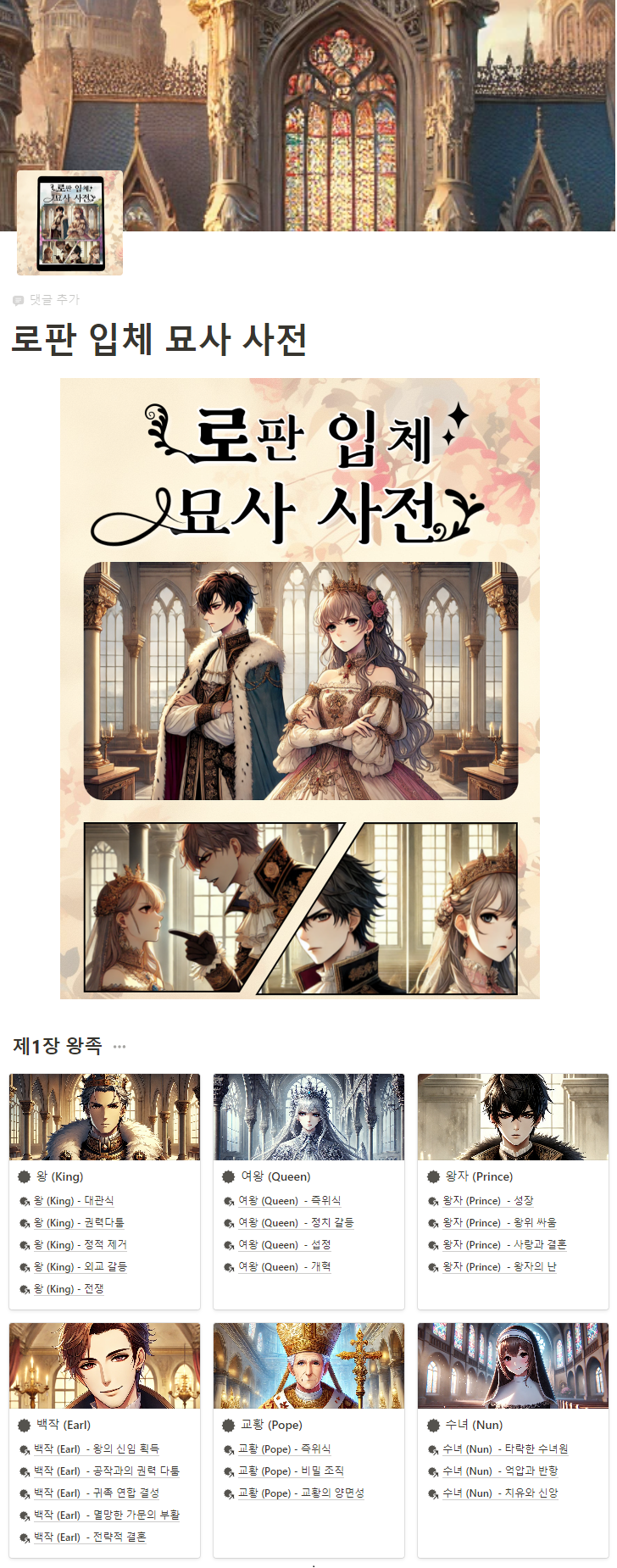

[Table of Contents]
Chapter1Royal Family
1. King(King)
1) Coronation
- Space & Atmosphere
- Appearance
- Costume
2) Power Struggle
- Space & Atmosphere
- Appearance
- Costume
3) Elimination of Political Rivals
- Space & Atmosphere
- Appearance
- Costume
4) Diplomatic Conflict
- Space & Atmosphere
- Appearance
- Outfit
5) War
- Space & Atmosphere
- Appearance
- Outfit
2. Queen (Queen)
1) Coronation
- Space & Atmosphere
- Appearance
- Outfit
2) Political Conflict
- Space & Atmosphere
- Appearance
- Outfit
3) Regency
- Space & Atmosphere
- Appearance
- Costume
4) Reform
- Space & Atmosphere
- Appearance
- Costume
3. Prince(Prince)
1) Growth
- Space & Atmosphere
- Appearance
- Costume
2. Struggle for the Throne
- Space & Atmosphere
- Appearance
- Costume
3) Love and Marriage
- Space & Atmosphere
- Appearance
- Costume
4) Prince's Rebellion
- Space & Atmosphere
- Appearance
- Outfit
4. Princess(Princess)
1) Birth
- Space & Atmosphere
- Appearance
- Outfit
2) Court Etiquette
- Space & Atmosphere
- Appearance
- Outfit
3) Ball
- Space & Atmosphere
- Appearance
- Outfit
4) Political Tool
- Space & Atmosphere
- Appearance
- Costume
5) Rebel Forces' Revenge
- Space & Atmosphere
- Appearance
- Costume
Chapter2Noble
1. Grand Duke(Grand Duke)
1) Usurpation of the Throne
- Space & Atmosphere
- Appearance
- Costume
2) Assassination of the Crown Prince
- Space & Atmosphere
- Appearance
- Costume
3) Secret Plot
- Space & Atmosphere
- Appearance
- Outfit
2. Duke(Duke)
1) Intervention in Succession to the Throne
- Space & Atmosphere
- Appearance
- Outfit
2) Creating a Puppet King
- Space & Atmosphere
- Appearance
- Outfit
3) Eliminating Hostile Nobles
- Space & Atmosphere
- Appearance
- Outfit
4) Rebellion
- Space & Atmosphere
- Appearance
- Outfit
3. Marquis (Byeon Gyeong-baek)
1) Border Defense
- Space & Atmosphere
- Appearance
- Outfit
2) Improvement Ceremony
- Space & Atmosphere
- Appearance
- Outfit
3) Betrayal of the Emperor
- Space & Atmosphere
- Appearance
- Outfit
4. Count (Earl)
1) Gaining the King's Trust
- Space & Atmosphere
- Appearance
- Outfit
2) Power struggle with the duke
- Space & atmosphere
- Appearance
- Outfit
3) Formation of the noble alliance
- Space & atmosphere
- Appearance
- Outfit
4) Revival of the fallen family
- Space & atmosphere
- Appearance
- Outfit
5) Strategic marriage
- Space & atmosphere
- Appearance
- Outfit
5. Viscount(Viscount)
1) Secret deal with the duke
- Space & atmosphere
- Appearance
- Outfit
2) Secret pact with the high nobility
- Space & atmosphere
- Appearance
- Outfit
3) Absence of the lord and the opportunity for regency
- Space & atmosphere
- Appearance
- Outfit
6. Baron(Baron)
1) Apprenticeship in a high-ranking noble family
- Space & atmosphere
- Appearance
- Outfit
2) Hardships of a local lord
- Space & atmosphere
- Appearance
- Outfit
3) Ambition and Conspiracy
- Space & Atmosphere
- Appearance
- Costume
7. Maid
1) Princess Surveillance
- Space & Atmosphere
- Appearance
- Costume
2) Forbidden Love
- Space & Atmosphere
- Appearance
- Costume
3) Palace Intrigue
- Space & Atmosphere
- Appearance
- Costume
8. Attendant
1) Helper
- Space & Atmosphere
- Appearance
- Outfit
2) Sacrifice
- Space & Atmosphere
- Appearance
- Outfit
3) Conspiracy
- Space & Atmosphere
- Appearance
- Outfit
Chapter3Article
1) Page (Page)
- Space & Atmosphere
- Appearance
- Costume
2) Training
- Space & Atmosphere
- Appearance
- Costume
3) Chivalry
- Space & Atmosphere
- Appearance
- Costume
4) Battle
- Space & Atmosphere
- Appearance
- Costume
5) Commanding the Knights
- Space & Atmosphere
- Appearance
- Costume
7) Warrior
- Space & Atmosphere
- Appearance
- Costume
8) Knight Errant
- Space & Atmosphere
- Appearance
- Costume
Chapter4Clergy
1. Pope(Pope)
1) Coronation
- Space & Atmosphere
- Appearance
- Costume
2) Secret Organization
- Space & Atmosphere
- Appearance
- Costume
3) Duality of the Pope
- Space & Atmosphere
- Appearance
- Outfit
2. Cardinal(Cardinal)
1) Shadow of Power
- Space & Atmosphere
- Appearance
- Outfit
2)Hidden Desire
- Space & Atmosphere
- Appearance
- Outfit
3) Conspiracy of the Vatican
- Space & Atmosphere
- Appearance
- Outfit
3. Bishop(Bishop)
1) Corruption of the Church
- Space & Atmosphere
- Appearance
- Outfit
2) Forbidden Desire
- Space & Atmosphere
- Appearance
- Outfit
3) Division and Conspiracy of the Church
- Space & Atmosphere
- Appearance
- Outfit
4. Priest(Priest)
1) Corrupt Clergy
- Space & Atmosphere
- Appearance
- Outfit
2) Corruption and Conspiracy of the Church
- Space & Atmosphere
- Appearance
- Costume
3) Heresy and Priest
- Space & Atmosphere
- Appearance
- Costume
5. Monk(Monk)
1) Daily Life of a Monk
- Space & Atmosphere
- Appearance
- Costume
2) Spiritual Practice and Study
- Space & Atmosphere
- Appearance
- Costume
3) Corrupt Monastery
- Space & Atmosphere
- Appearance
- Costume
6. Nun(Nun)
1) Corrupted Convent
- Space & Atmosphere
- Appearance
- Costume
2) Oppression and Rebellion
- Space & Atmosphere
- Appearance
- Costume
3) Healing and Faith
- Space & Atmosphere
- Appearance
- Costume
Chapter5Palace& Noble Officials
1. Royal Family
1) Tutor
- Space
- Education
2) Royal Costume Design Room
- Space
- Design
3) Royal Guard
- Space
- Security
4) Gatekeeper
- Space
- Surveillance
2. Nobility
1) Butler
- Space
- Management
2) Barbershop
- Space
- Beauty
3. Common
1) Nanny
- Space
- Childcare
2) Gardener
- Space
- Landscaping
3) Servant
- Space
- Service
4) Coachman
- Space
- Transportation & Management
Chapter6Law and Religion
1) Priest
- Space
- Ritual
2) Judge
- Space
- Trial
3) Bailiff
- Space
- Law enforcement
4) Warden
- Space
- Management & control
Chapter7Treatment&Healing
1) Doctor
- Space
- Surgery
2) Pharmacist
- Space
- Work
3. Astrologer
- Space
- Viscosity
Chapter6Artist
1) Bard
- Space
- Poetry Reading
2) Musician
- Space
- Music
3) Painter
- Space
- Painting
4) Dancer
- Space
- Dance
5) Perfumer
- Space
- Work
6) Acrobat
- Space
- Acrobatics
7) Clown
- Space
- Clown Play
Chapter 9Merchant
*Common
1) Guild Leader
- Space
- Management & Guidance
2) Farmer
- Space
- Farming
*Food and Beverage
1) Grocer
- Space
- Groceries
2) Baker
- Space
- Bread
3) Butcher
- Space
- Butchery
4) Fishmonger
- Space
- Fish
5) Brewer
- Space
- Brewing
6) Winery
- Space
- Winemaking
7) Chef
- Space
- Cooking
- Taste of food
8) Vegetable and fruit vendor
- Space
- Sales
* Architecture and crafts
1) Architect
- Space
- Work
2) Carpenter
- Space
- Work
3) Blacksmith
- Space
- Work
4) Tanner
- Space
- Work
5) Potter
- Space
- Work
6) Jeweler
- Space
- Work
7) Sculptor
- Space
- Work
3) S-Class Weapon Setting Book (Free with Pre-order)
One of the most important things when writing fantasy novels and game scenarios is weapon settings.
The fun of battles changes depending on the weapon settings. Especially for main characters, you need to create good weapons, which can be quite a dilemma.
That's why we made this!
Weapons are divided into warrior, mage, religion, and support, providing 64 S-class weapon settings.
No more struggling and suffering over weapon settings.
Get inspiration from the setting book and use it freely.
[Table of Contents]
Chapter 1: Warrior Weapons
▶Sword
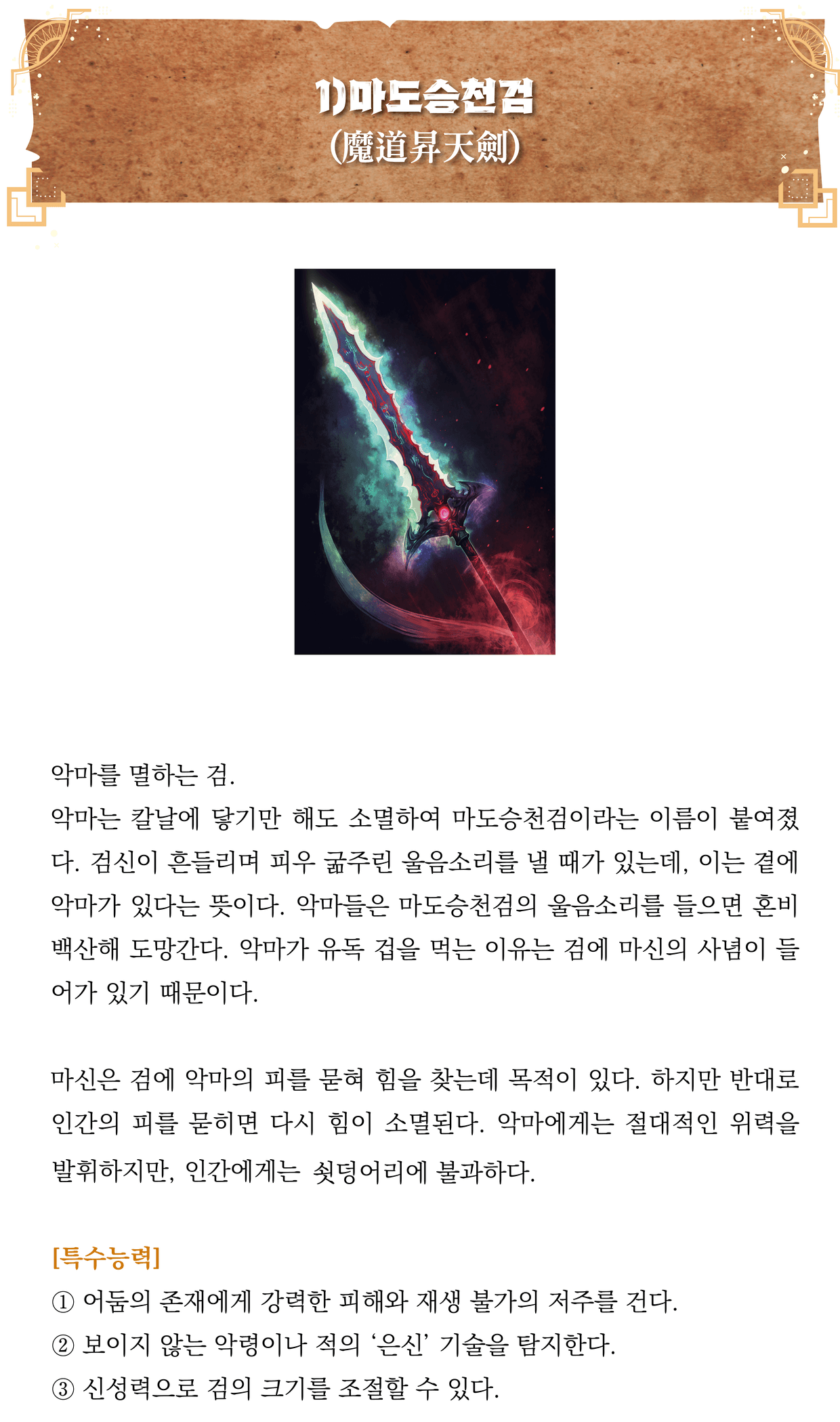
1) Magic Ascension Sword
2) Executioner
3) Wind Cutter
4) Magic Booster
▶Spear
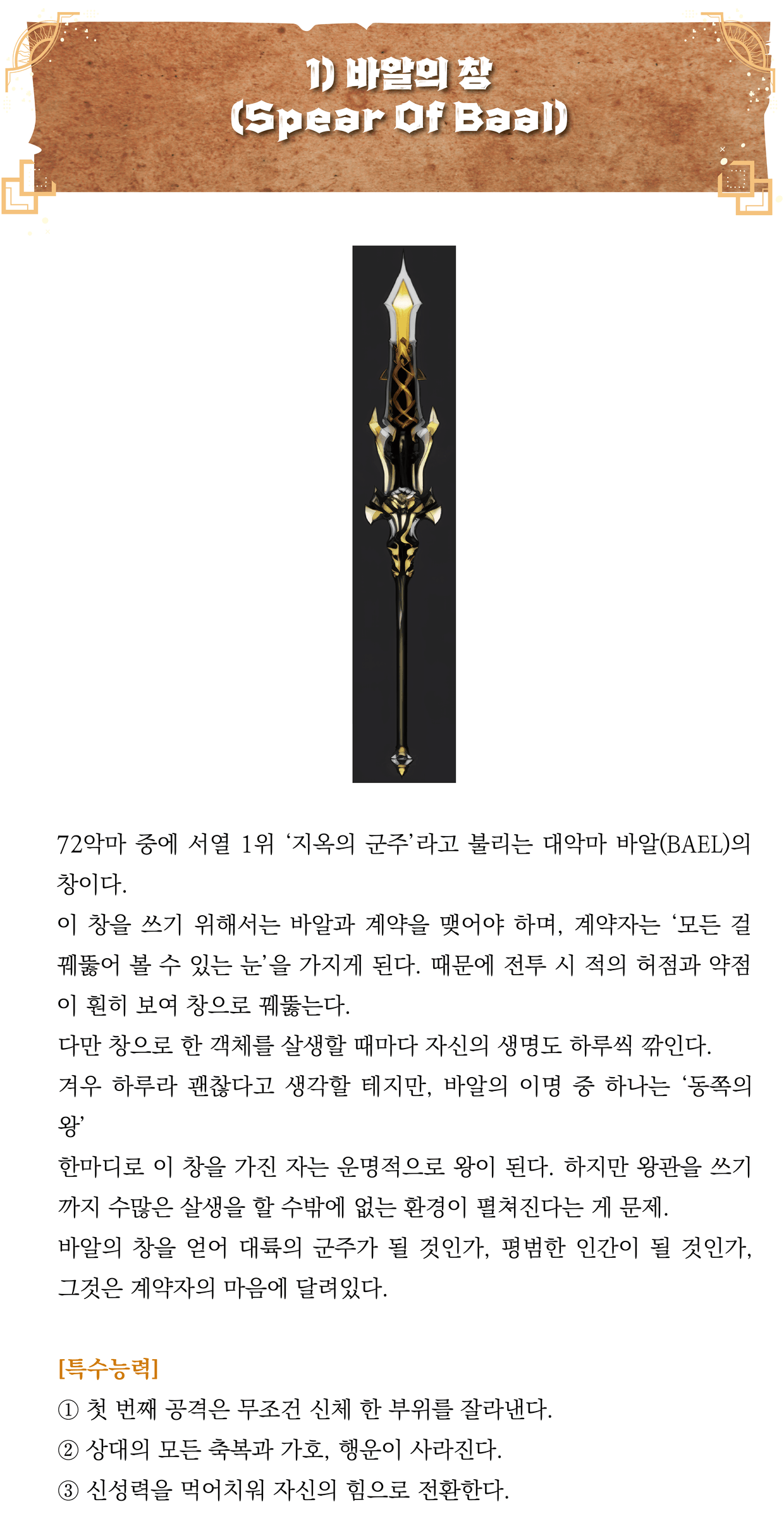
1) Spear of Baal
2) Gravity Controller
3) Magic Combiner
4) Pure Effort
▶Axe
1) Returning
2) Feather Ax
3) Destroyer
4) Predator
▶Dagger
1) Counter Wedge
2) Contract Breaker
3) Snake Spiral
4) Hidden Blade
▶Bow
1) Sorcerer of Bow
2) Falling Star
3) Thousand-yard Stare
▶Throwing Weapon
1) Shadow Walker
2) Chameleon
3) Moon Light
4) Switching
▶Shield
1) Reflector
2) Dragon Head
3) Crusaders
4) Ancestor
Chapter 2: Wizard Weapons
▶Magic Staff
1) Prism
2) Scepter
3) Adrenaline
4) Harmony
▶Grimoire
1) Black Lion Book
2) Vanitas Skeleton
3) Magia Effingo
4) Diabolos
▶Mana Marble
1) Master Flame Marble
2) Lightning Shock Marble
3) Gravity Mana Marble
4) Parasitic Mana Marble
▶Magic Card
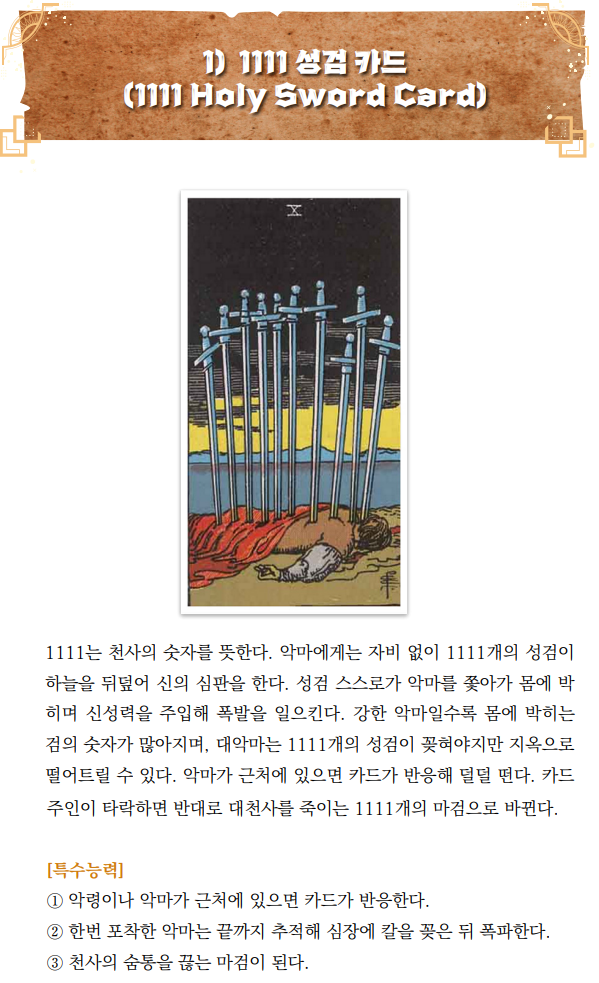
1) 1111 Holy Sword Card
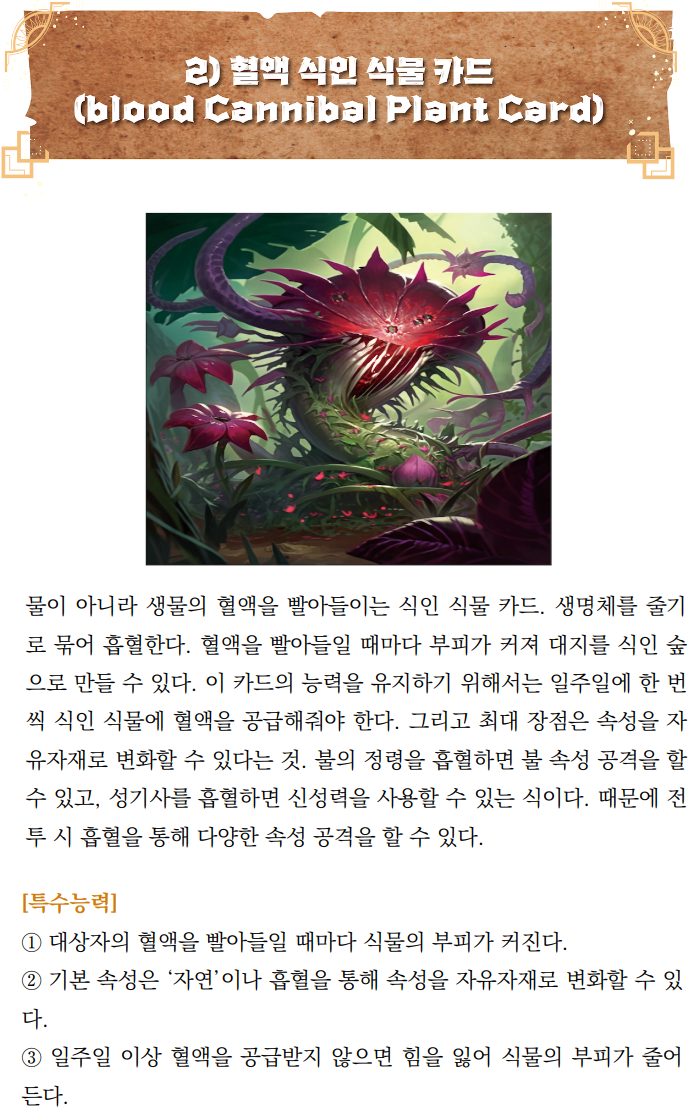
2) Blood Cannibal Plant Card
3) Mandala Potion Card
4) Devil Mirror Prison Card
▶Shaman Staff
1) Evil Eye
2) Soul Crystal Wand
3) Soul Sickle Wand
4) Ancient Beast
Chapter 3: Religious Weapons
▶Bible
1) Fallen Angel Bible
2) Messenger Bible
3) 4th Angel Bible
4) Mental Domination Bible
▶Cross
1) Hellfire Cross
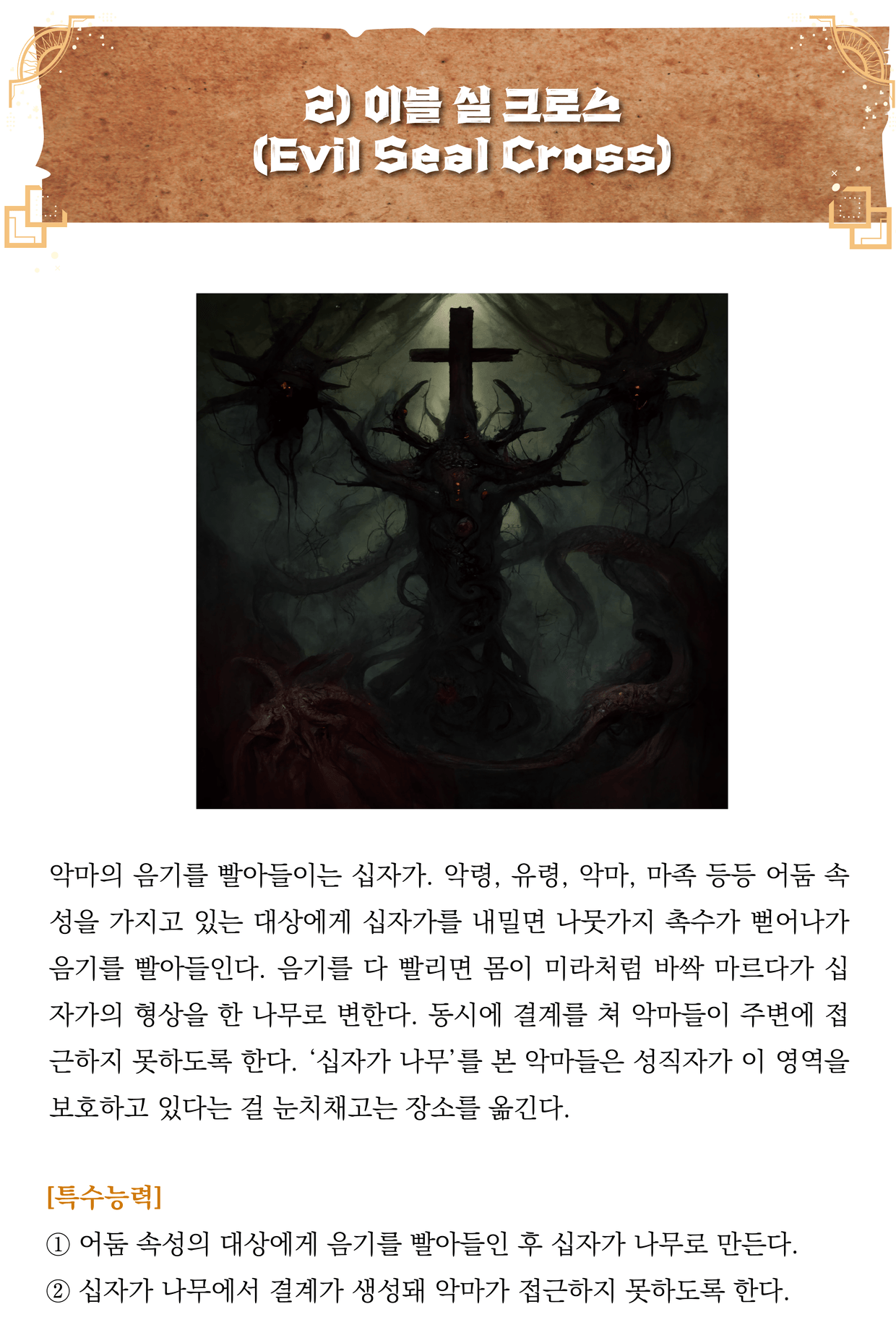
2) Evil Seal Cross
3) Deliriousness Cross
4) Four Angel Eyes Cross
Chapter 4: Support Weapons
▶Instrument
1) Perfume Harp
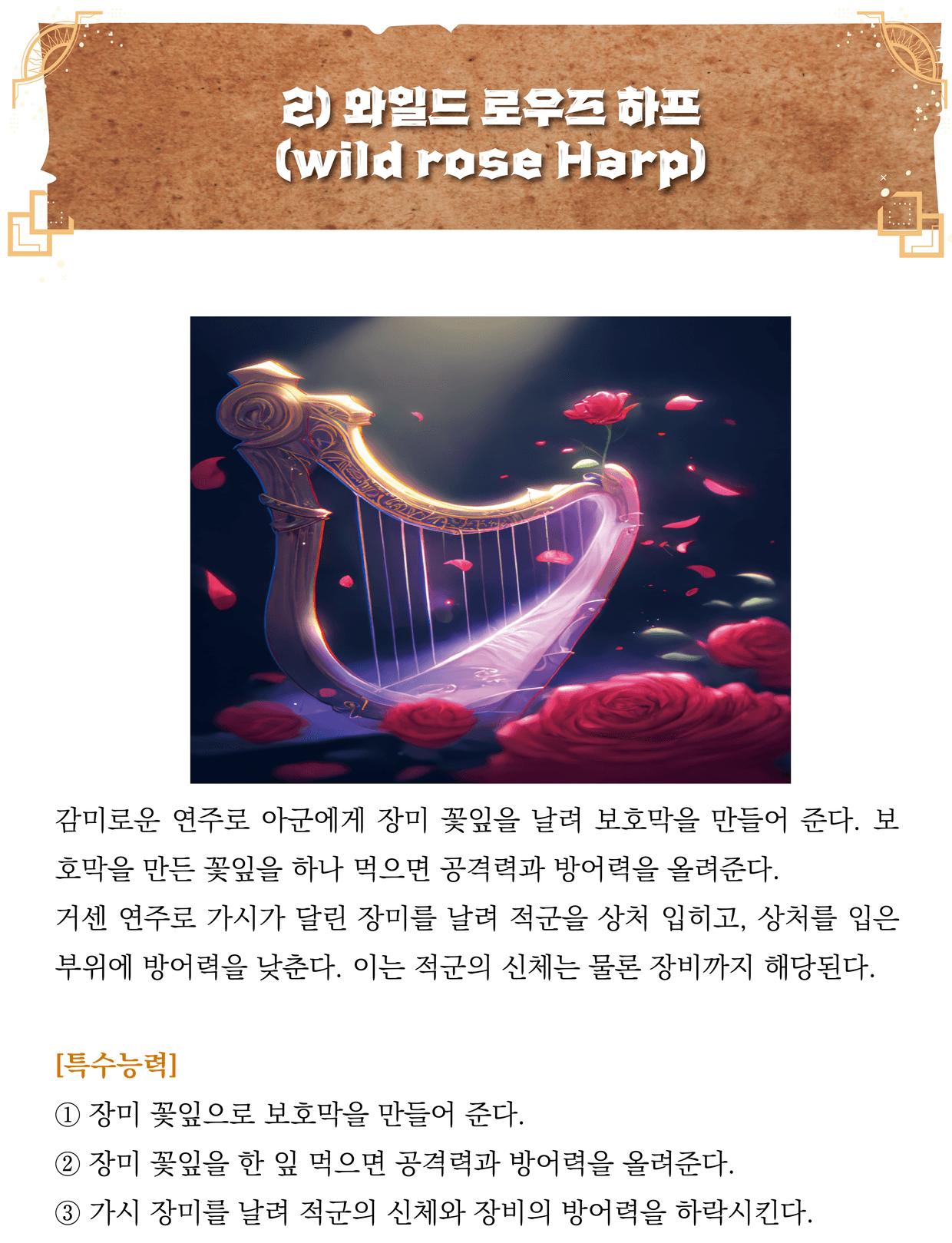
2) Wild Rose Harp
3) Avoiding Precision Lute
4) Locating Ocarina
▶Astrology Bead
1) Constellation Fortune Bead
2) Change Of Fate
3) Life And Death Bead
4) Seven Evasions
[Preview of Contents]
Reward Composition
Maker Introduction

Why Wadiz?

『Character & Story Creation Techniques』
History is not just a record of the past.
Countless tragedies and glories, politics and intrigue, love and ruin are the narratives that breathe within.
That is why we decided to proceed.
We will guide you to build solid storytelling and character settings based on various historical materials.
『Romance Fantasy Descriptive Dictionary』
In romance and romance fantasy, a single word or line of description becomes a powerful weapon.
That is why we do not simply express rhetoric.
We delicately describe the character's personality, psychology, situation, and background to enhance the completeness of the work.
We will make sure this book is as satisfying as the many backers who have praised it.