 weareagent.co.kr
Nagao Kanekoma Seisakusho Co., Ltd.
Nagao Kanekoma Factory Co., Ltd.
Nagao Kanekoma Factory 130th Anniversary Special Edition (Japan)
Higonokami x Three Kingdoms: A Spirit-Infused Pocket Knife
About 130 years ago (Meiji 27, 1894), the first-generation founder, Komataro Nagao, began manufacturing the 'Hirata Knife' in Hirata, Miki City, Hyogo Prefecture, Japan (currently: Hirata, Miki City, Hyogo Prefecture). The current craftsman, Mitsuo Nagao, is the sole successor of Higonokami knives, inheriting five generations of tradition and manufacturing techniques. The Higonokami knives made by Nagao Kanekoma Factory are the one and only original Japanese Higonokami.
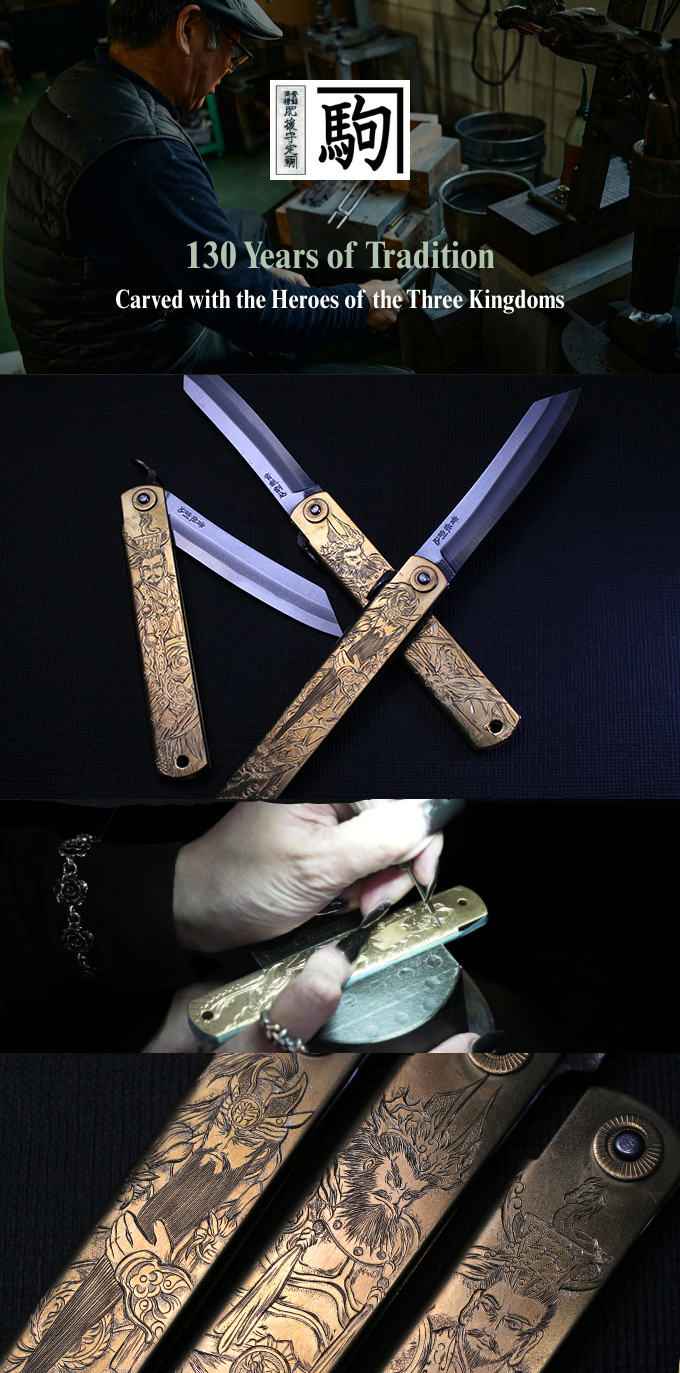
Celebrating 130 years in the making, this beautifully crafted knife has been engraved with the legendary Three Brothers!
To commemorate the 130th anniversary, the only legitimate successor of the Higonokami knife,
Nagao Kanekoma Factory Co., Ltd. presents the Wadiz exclusive Three Kingdoms edition.
Collectors around the world can obtain this knife after waiting up to two years.
Introducing three special editions by fifth-generation craftsman Mitsuo Nagao.
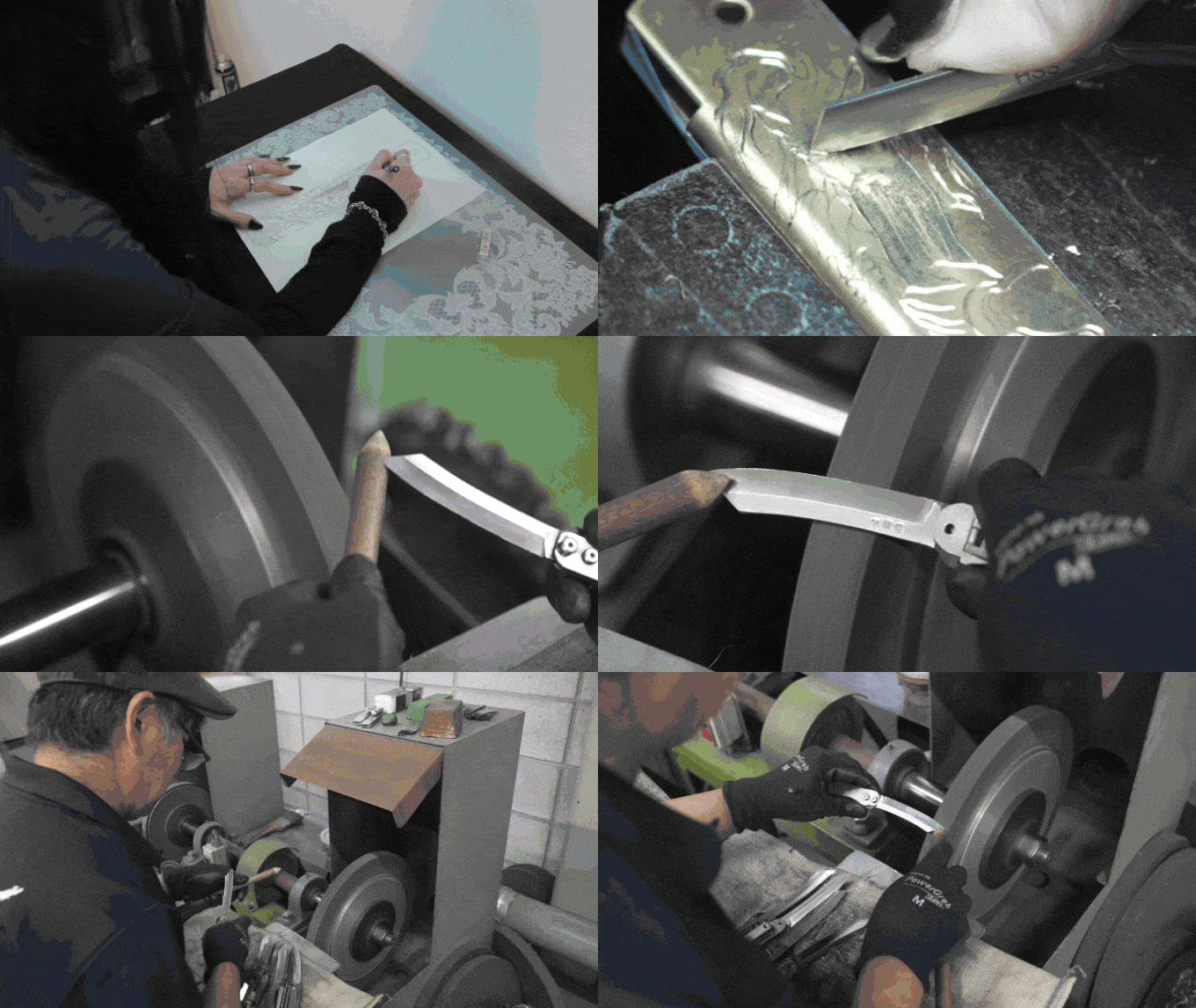
Actual production process

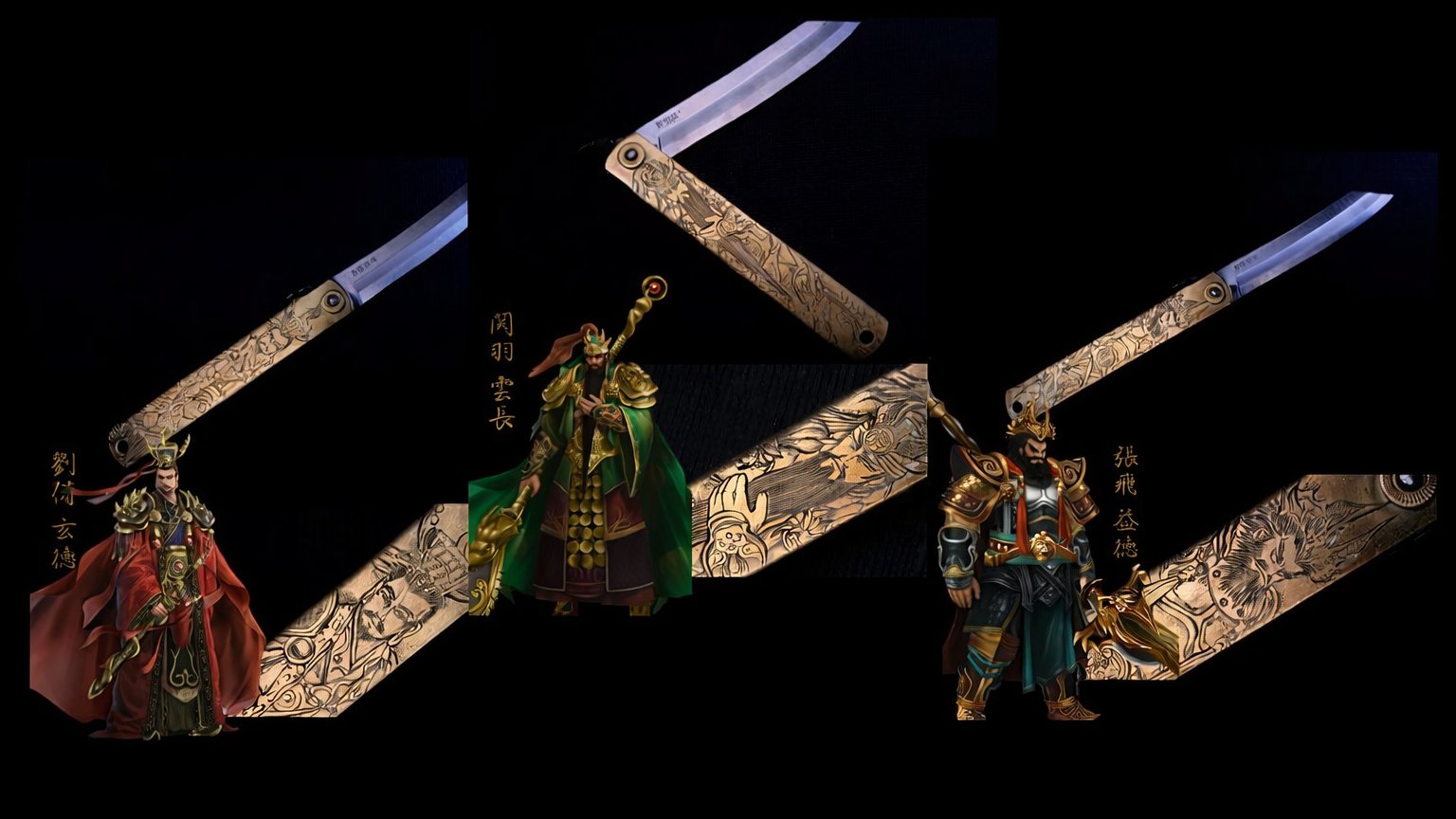
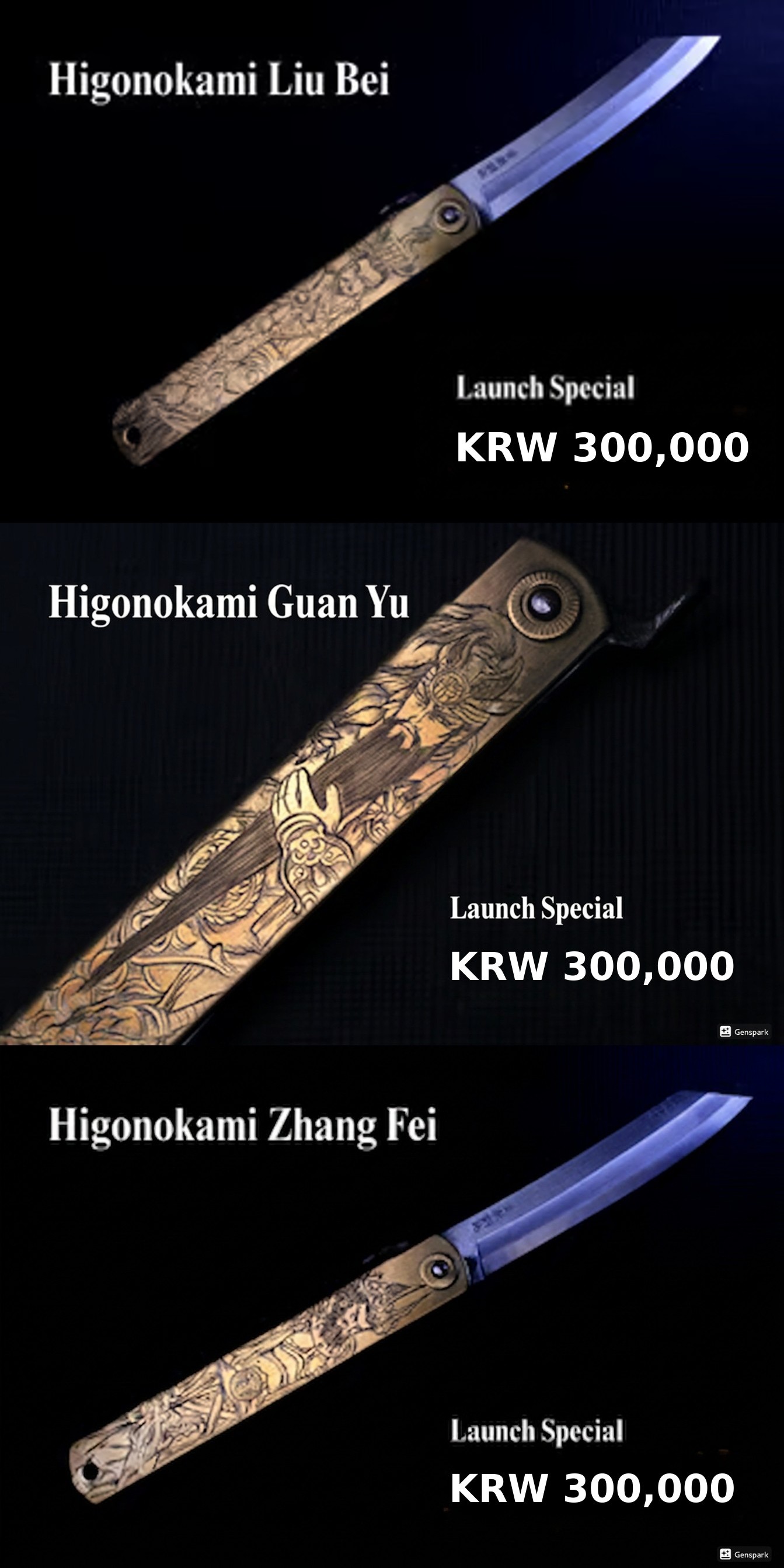
Each piece is intricately engraved with the legendary Three Brothers—Liu Bei, Guan Yu, and Zhang Fei.
This design was planned by the Korean game company K3K and brought to life through a vibrant collaboration with Mitsuo Nagao, the fifth-generation successor of Nagao Kanekoma Factory in Japan, and Chie. Every engraving is done by hand, not by machine, and only when all the knives are brought together does a complete work of art emerge.
The blade is made from Aogami #2 steel, renowned for its excellent sharpness, durability, and practical beauty.
The exclusive engraved model available only through this project combines a living story from the 1800s with the spirit and soul of 130 years of craftsmanship.
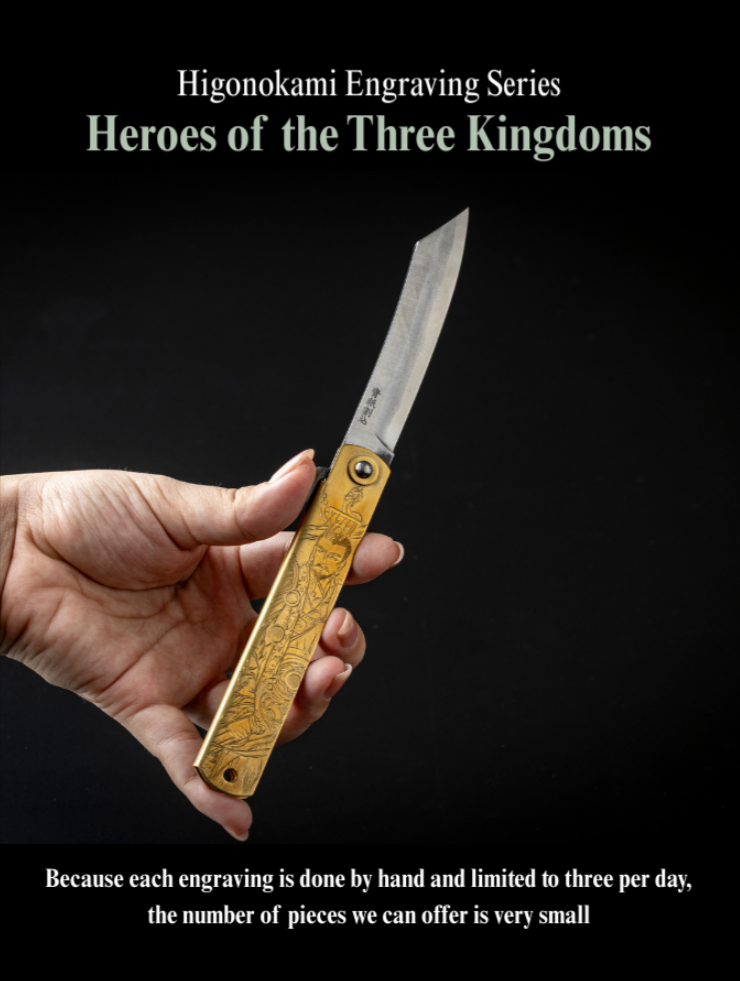
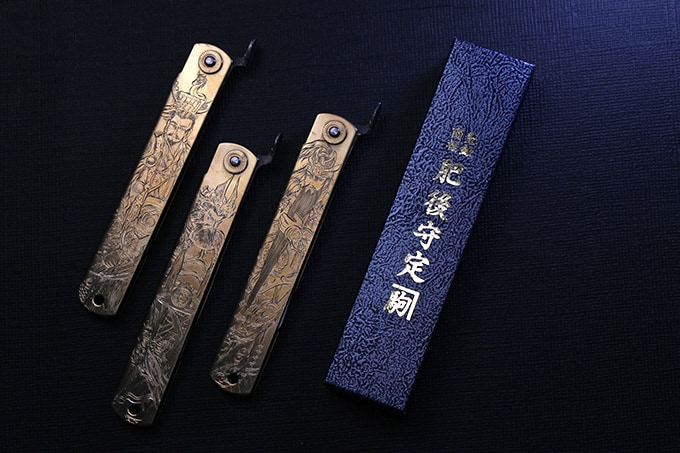
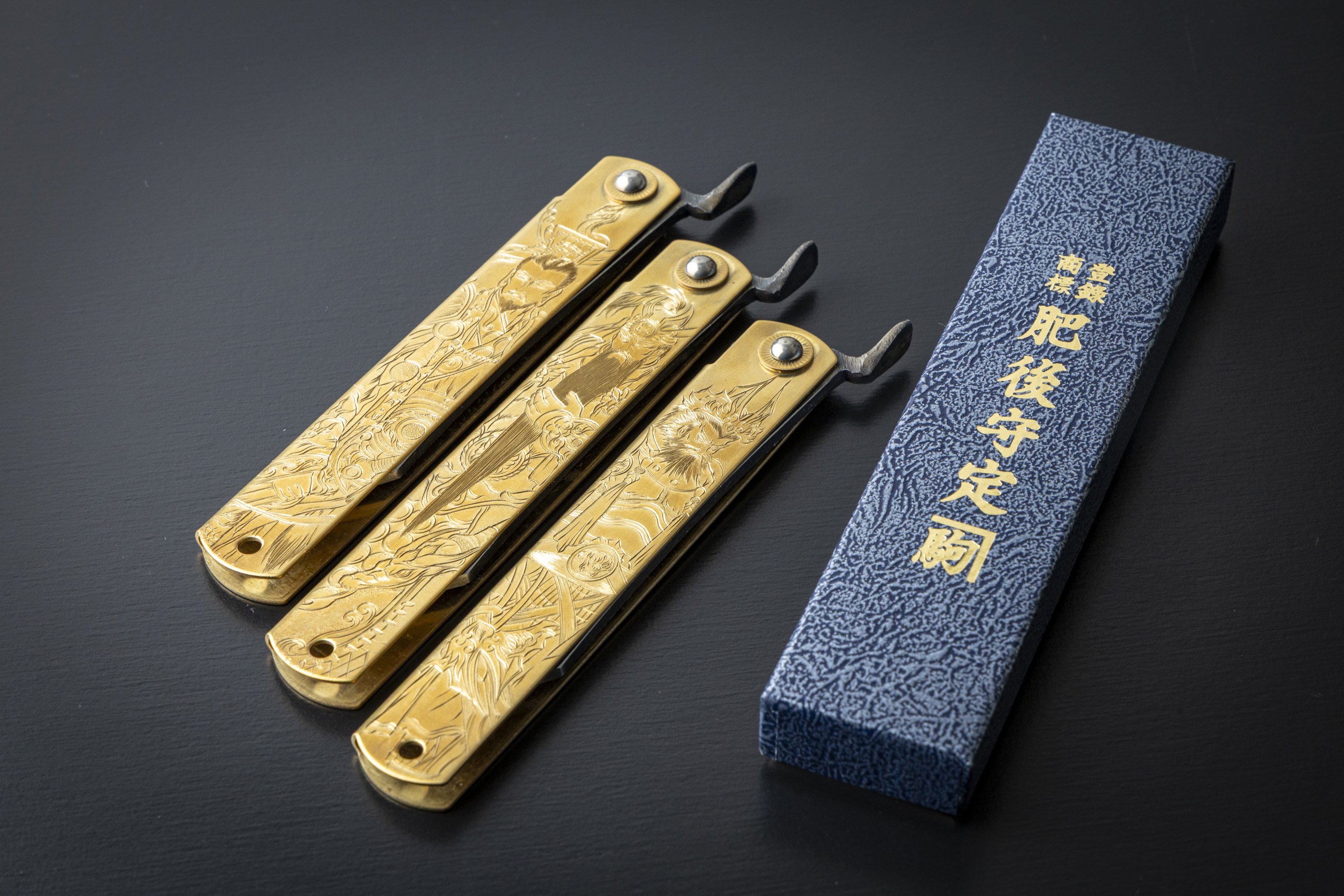
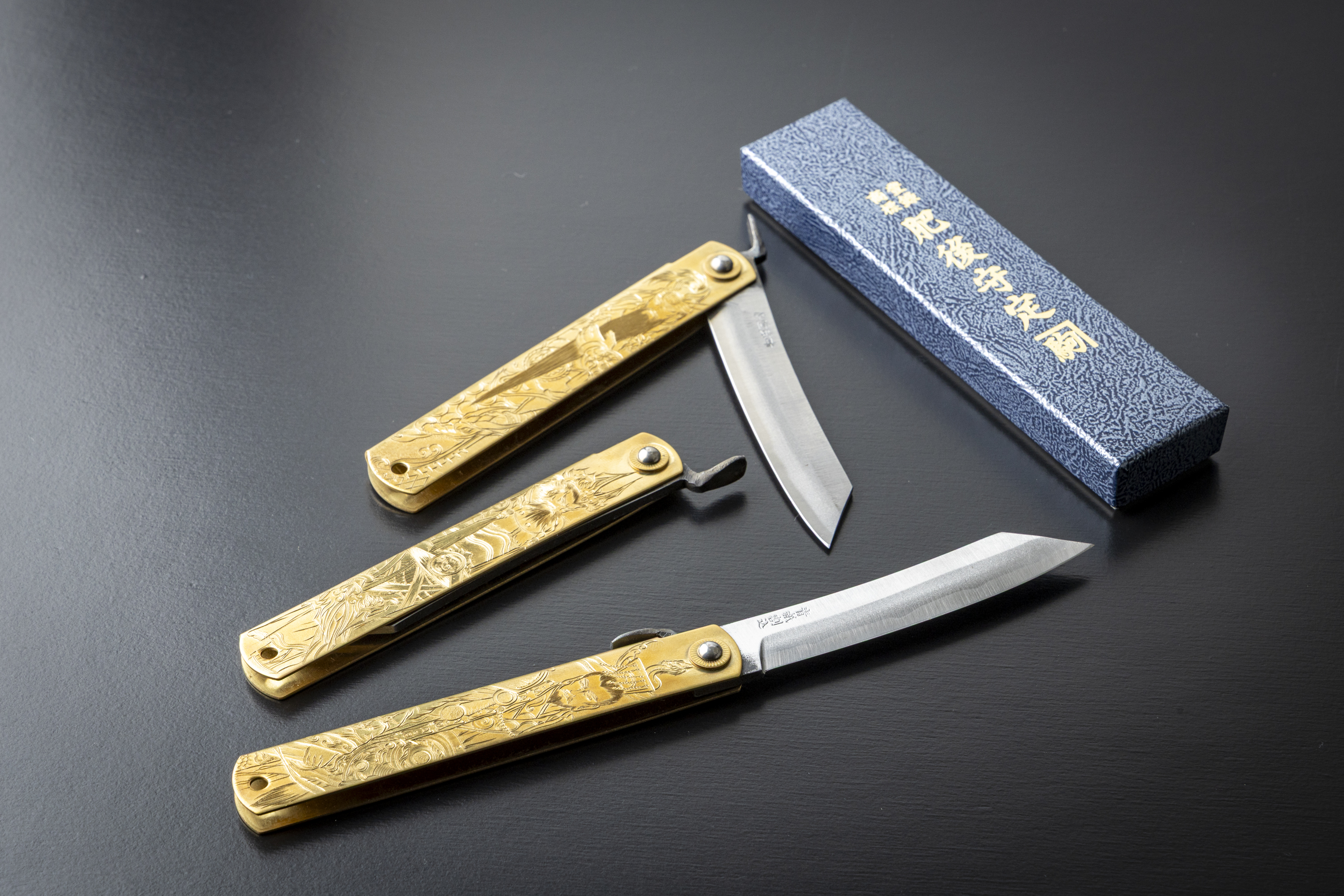


What is engraved on this knife is not mere decoration.
The master engraver carves the Three Kingdoms heroes with both strength and delicate sensibility.
It is such a delicate process that even the slightest movement of the hand changes the expressions of the heroes.
For this reason, even when carving the same character, no two pieces are ever identical.
Every piece is a true work of art, and only one exists in the world.
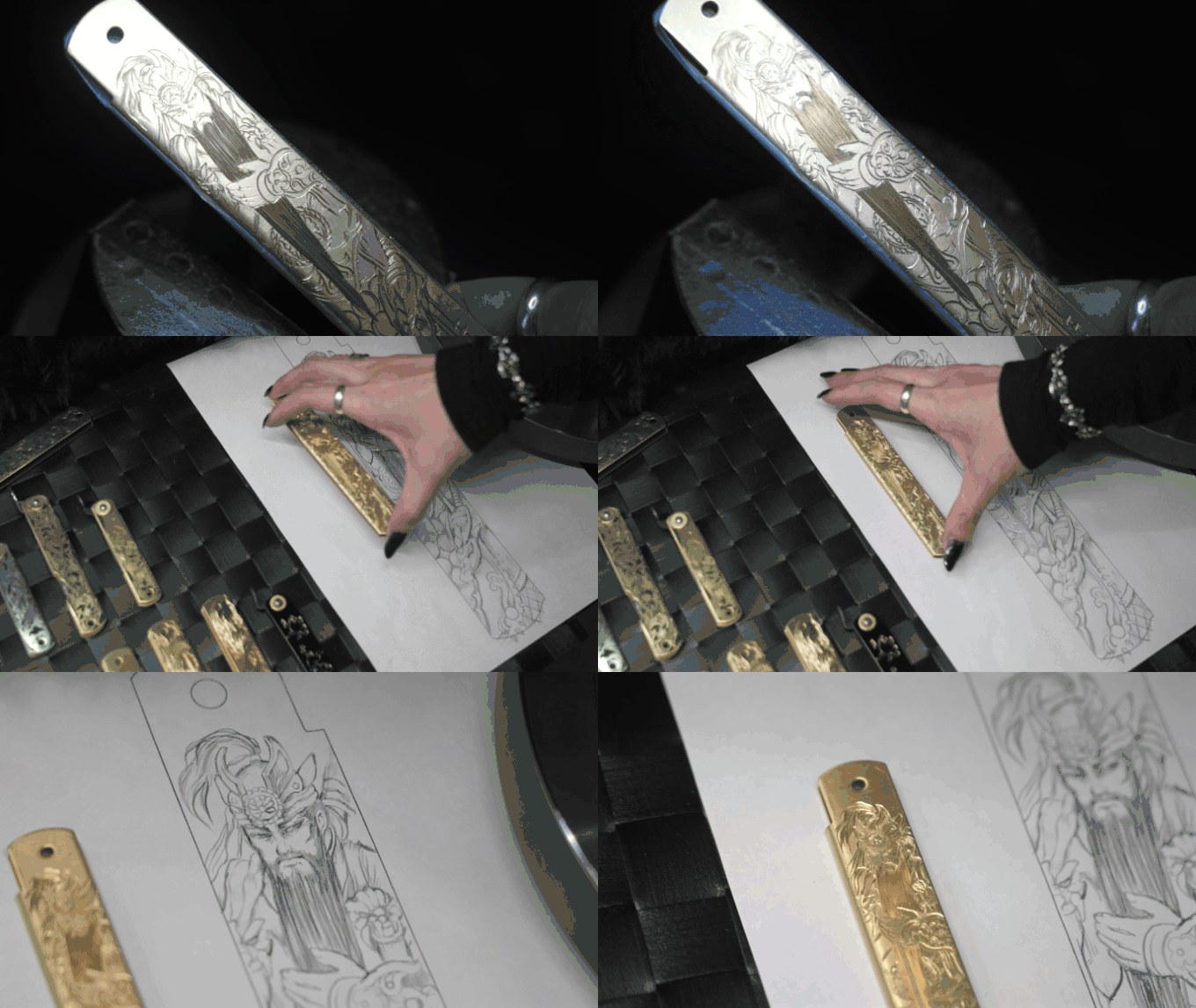
The depth and angle of each line absorb light, infusing the heroes' faces with dignity and vitality. The compassion of Liu Bei, the majesty of Guan Yu, and the boldness of Zhang Fei are all expressed with remarkable lifelikeness, even though they are engraved in metal.
This is a work imbued with warmth, intricacy, and the spirit of the artisan, which can only be completed by hand and cannot be replicated by machines.


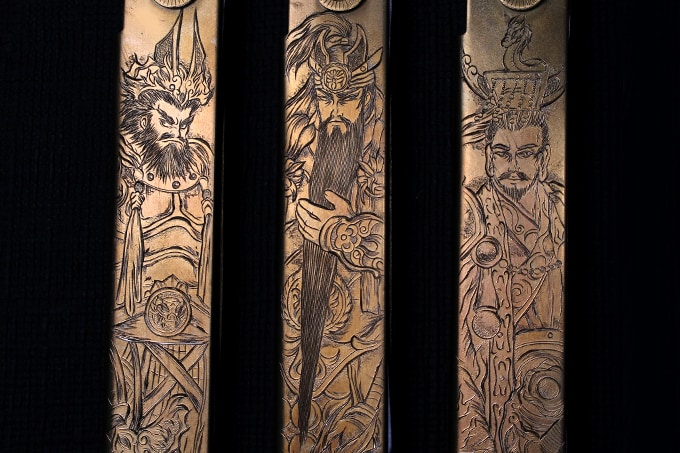
The unique character of each hero is delicately brought to life by the artisan's touch, as if the sheath itself is imbued with life.
Not a mechanically stamped shape,
It expresses the vivid, lifelike appearance of heroes as if they were shaped by hand.
Within a space of just a few centimeters, a grand narrative unfolds,
The delicate yet rich sculptural beauty naturally stirs the emotions of those who behold it.
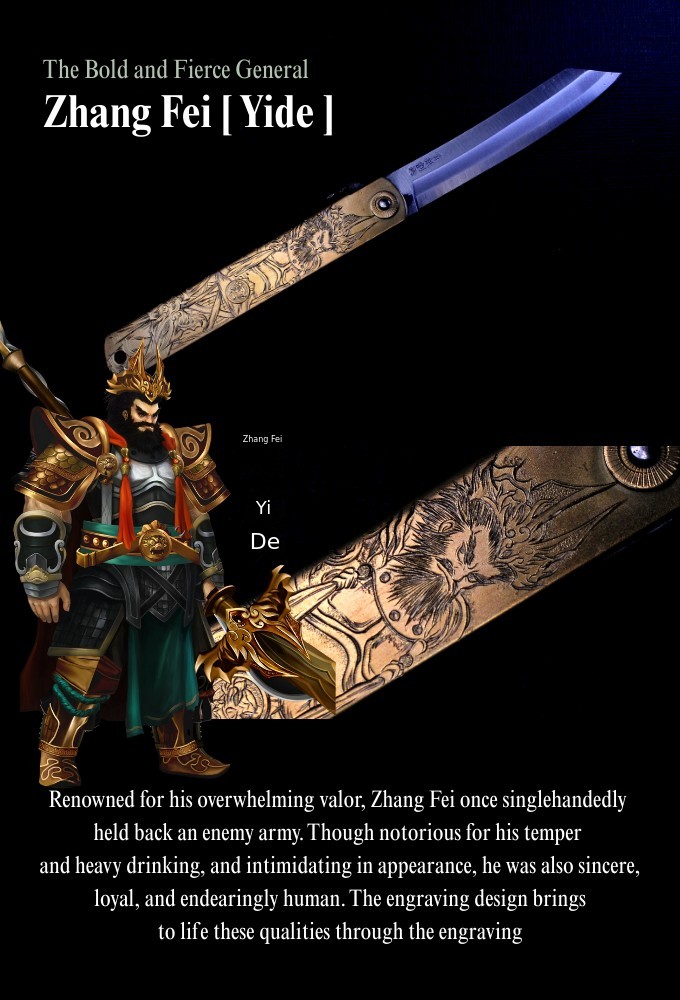
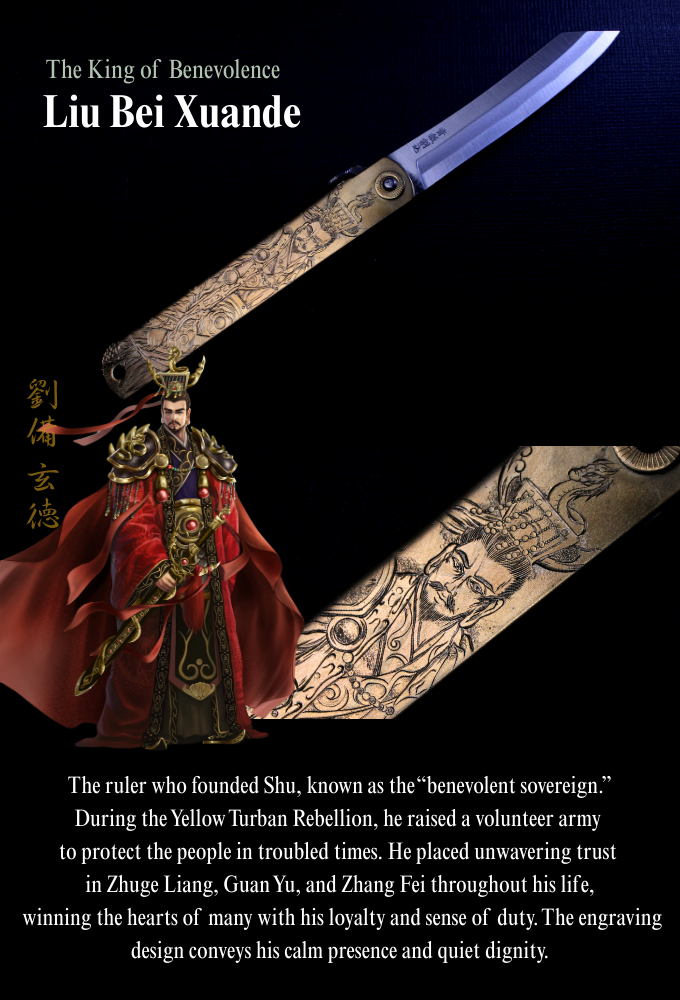
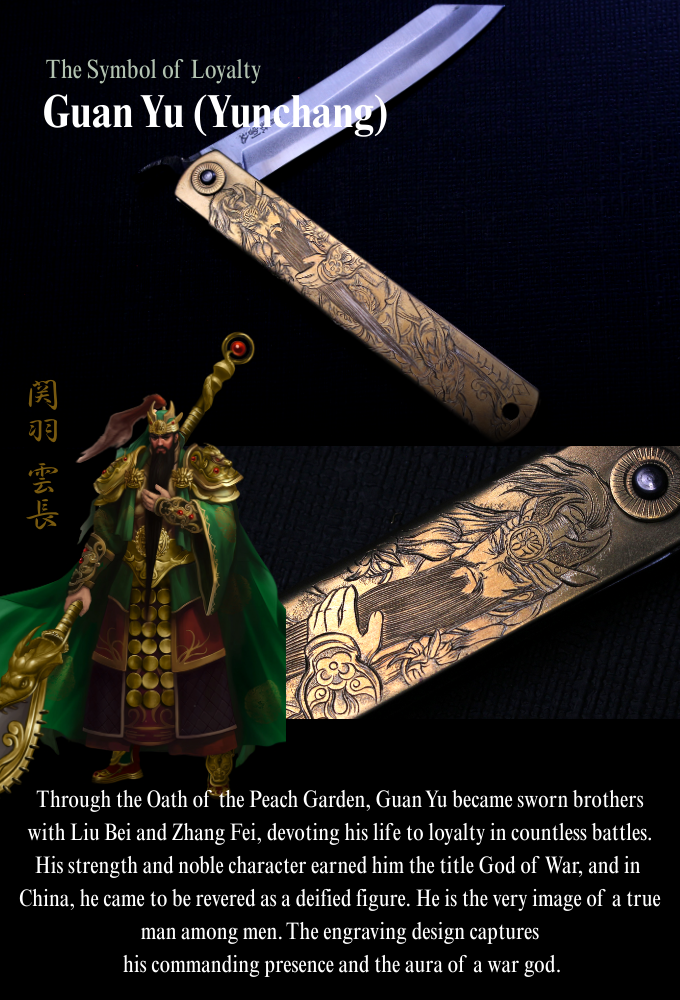

Aogami #2 is renowned for its exceptionally sharp edges, providing razor-like clean cuts. Among various types of steel, Aogami #2 is considered best for sharpness, edge retention, and ease of sharpening. Compared to traditional Shirogami steel, the addition of chromium and tungsten enhances both durability and wear resistance.
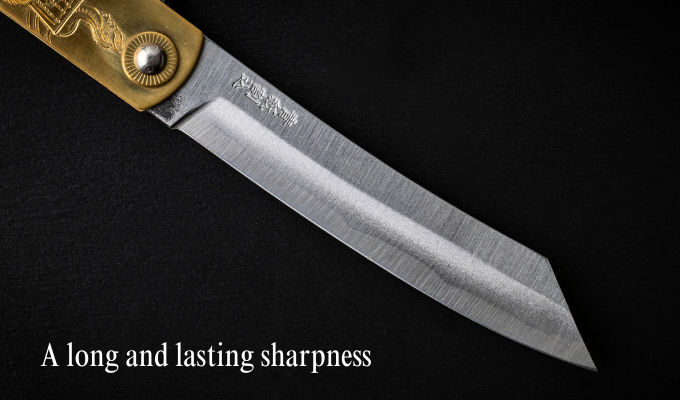
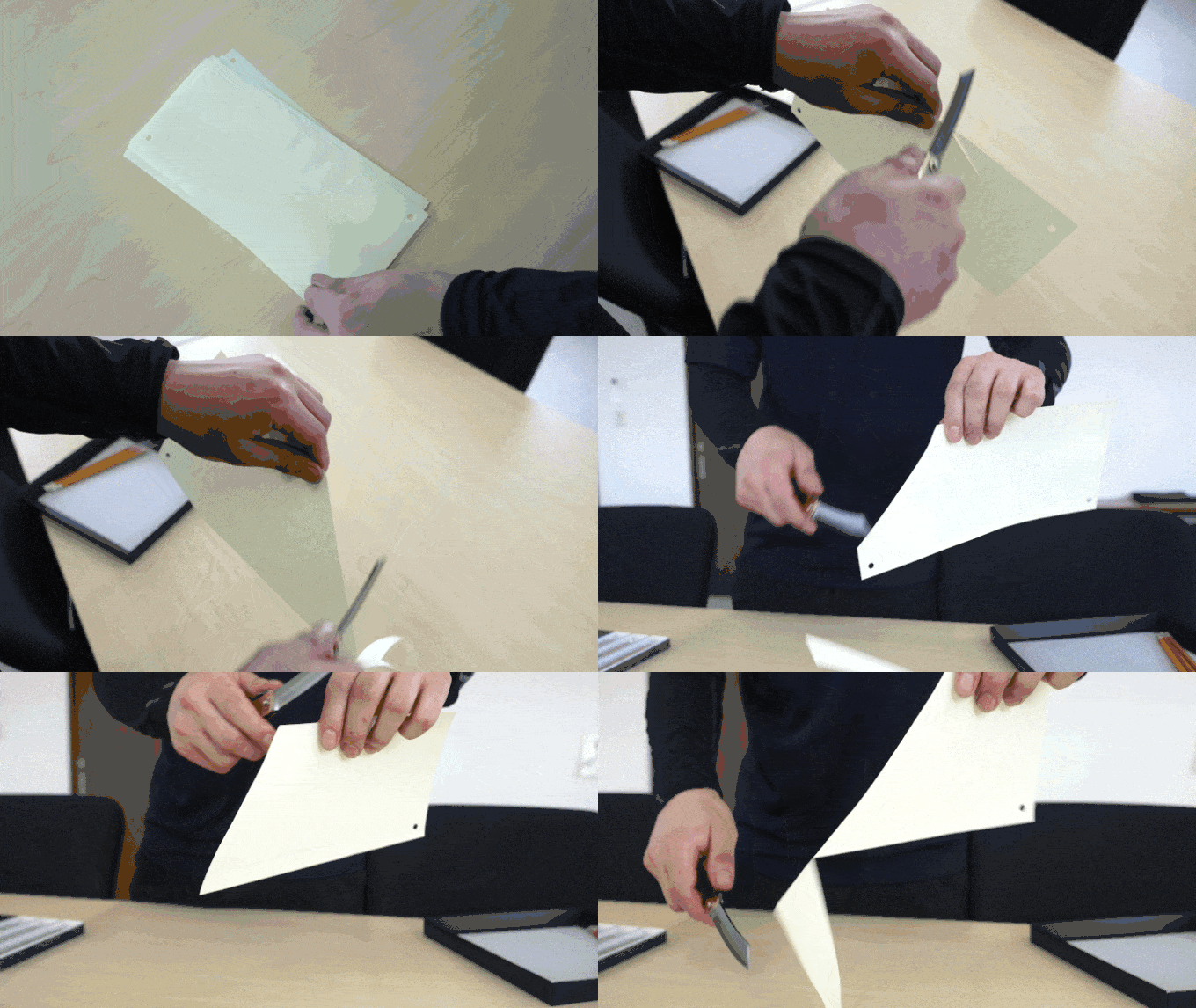
It maintains sharpness for a long time, and even as the edge gradually dulls, it continues to provide smooth and easy cuts, giving a unique sensation of gliding through food.
Aogami #2 offers durability by balancing hardness and flexibility, allowing it to withstand prolonged use. It delivers consistent sharpness not only for everyday tasks but also for delicate and precise work.

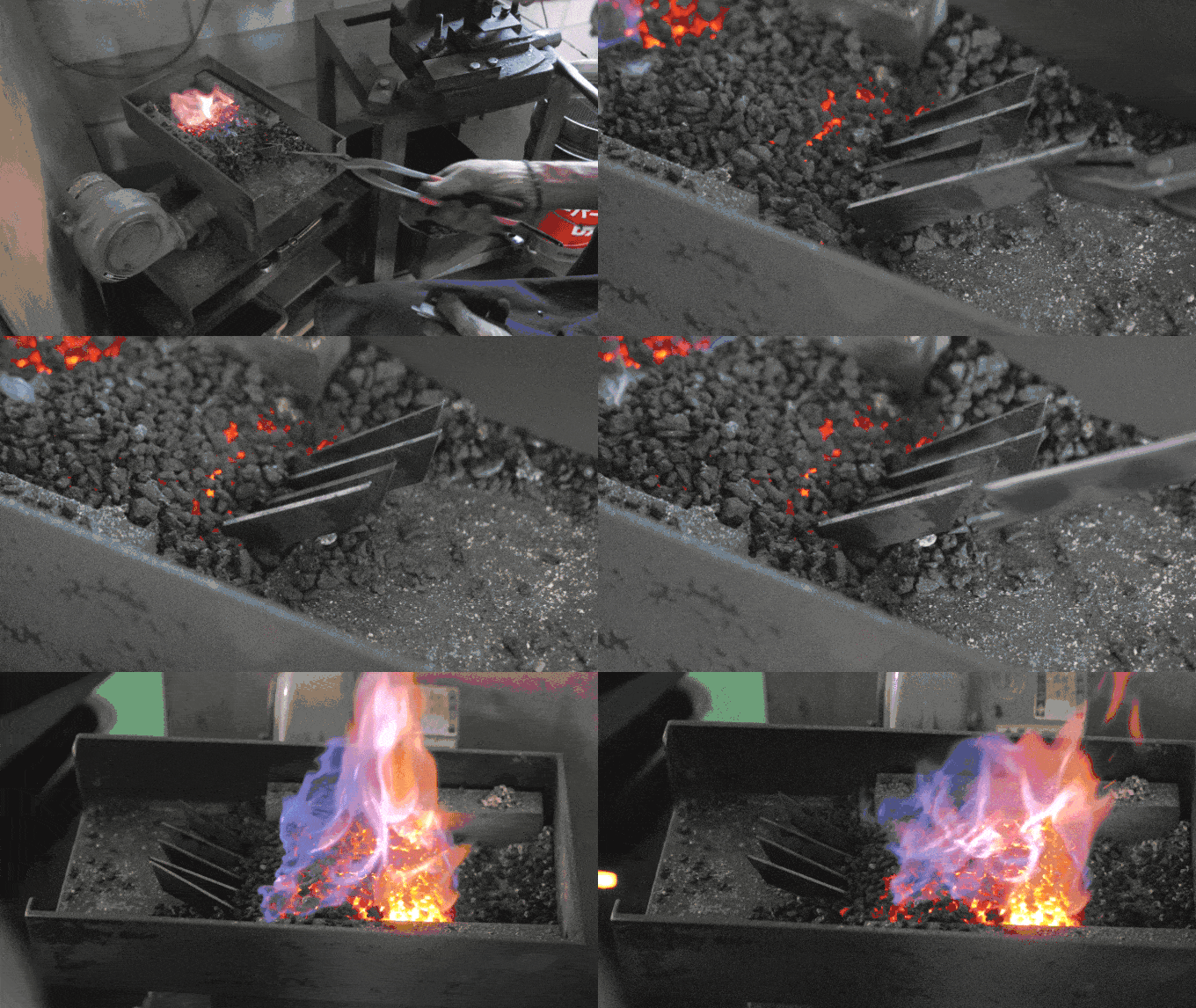
Heating
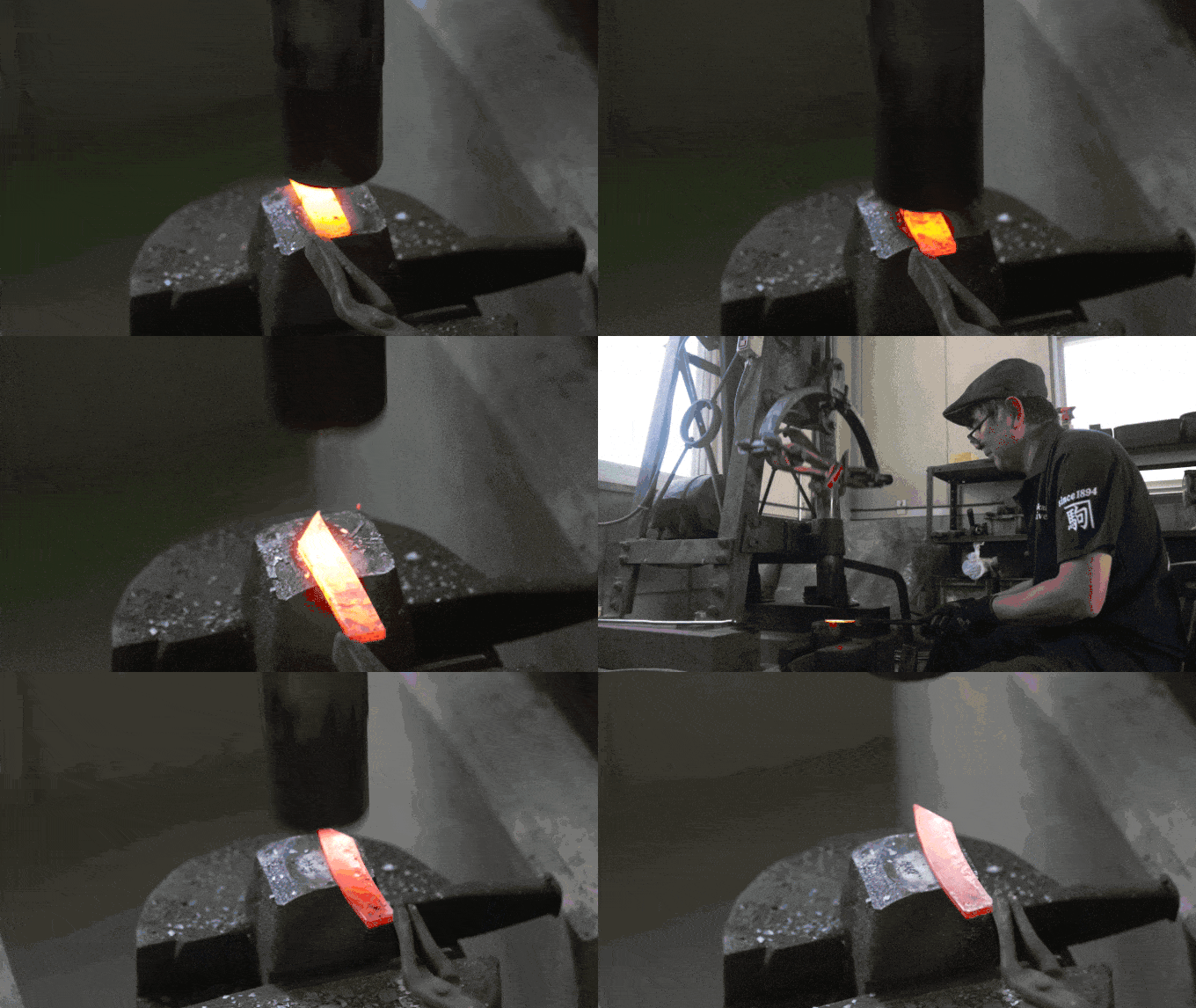
Tempering
During the tempering process, unique patterns form on the blade as it is forged with a hammer,
Through repeated forging, the steel's structure becomes denser, further enhancing its strength and durability.
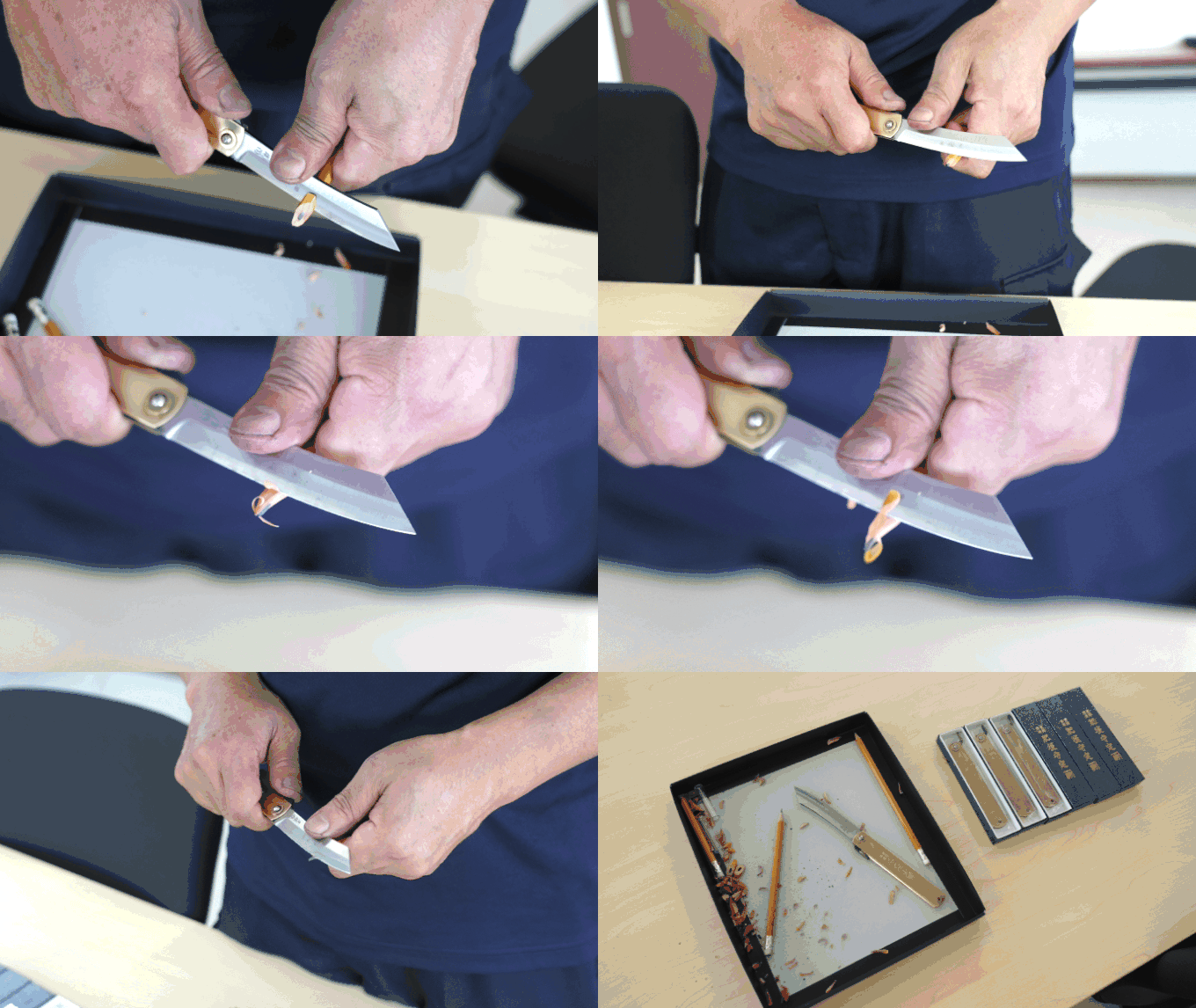
Sharpening with a rough grindstone & medium-grit grindstone
The knife is sharpened step by step using a rough-grit and a medium-grit whetstone.
Additionally, using a grinder completes the blade's sharpness and cutting ability while maintaining the steel's hardness.
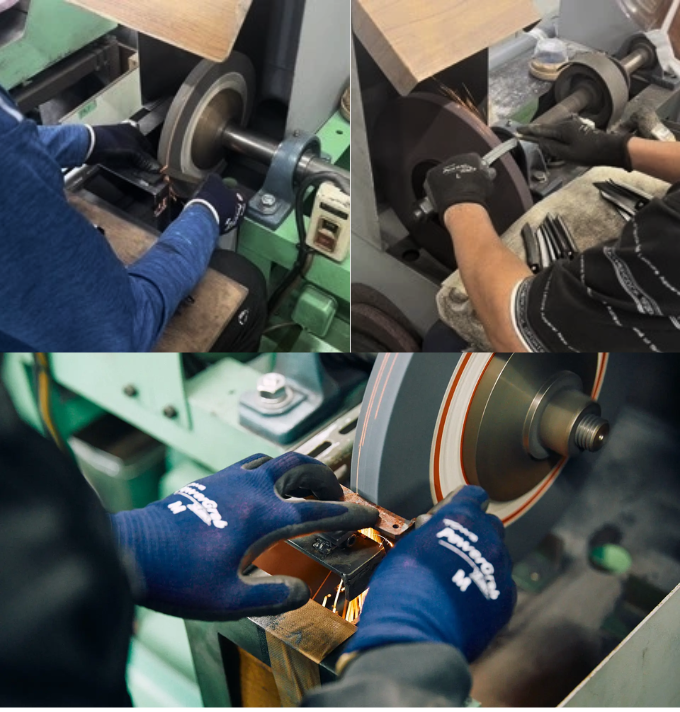
Cutting out the Material
Materials for the sheath, such as brass or iron, are cut to match the shape of the knife.


Engraving the sheath
The figures of the heroes are intricately engraved by the artisan's skilled hands, stroke by stroke.
Through delicate detailing, the work is completed with a sense of depth and outstanding expressiveness.
Adding the Hinge
The sheath and blade are fixed together.
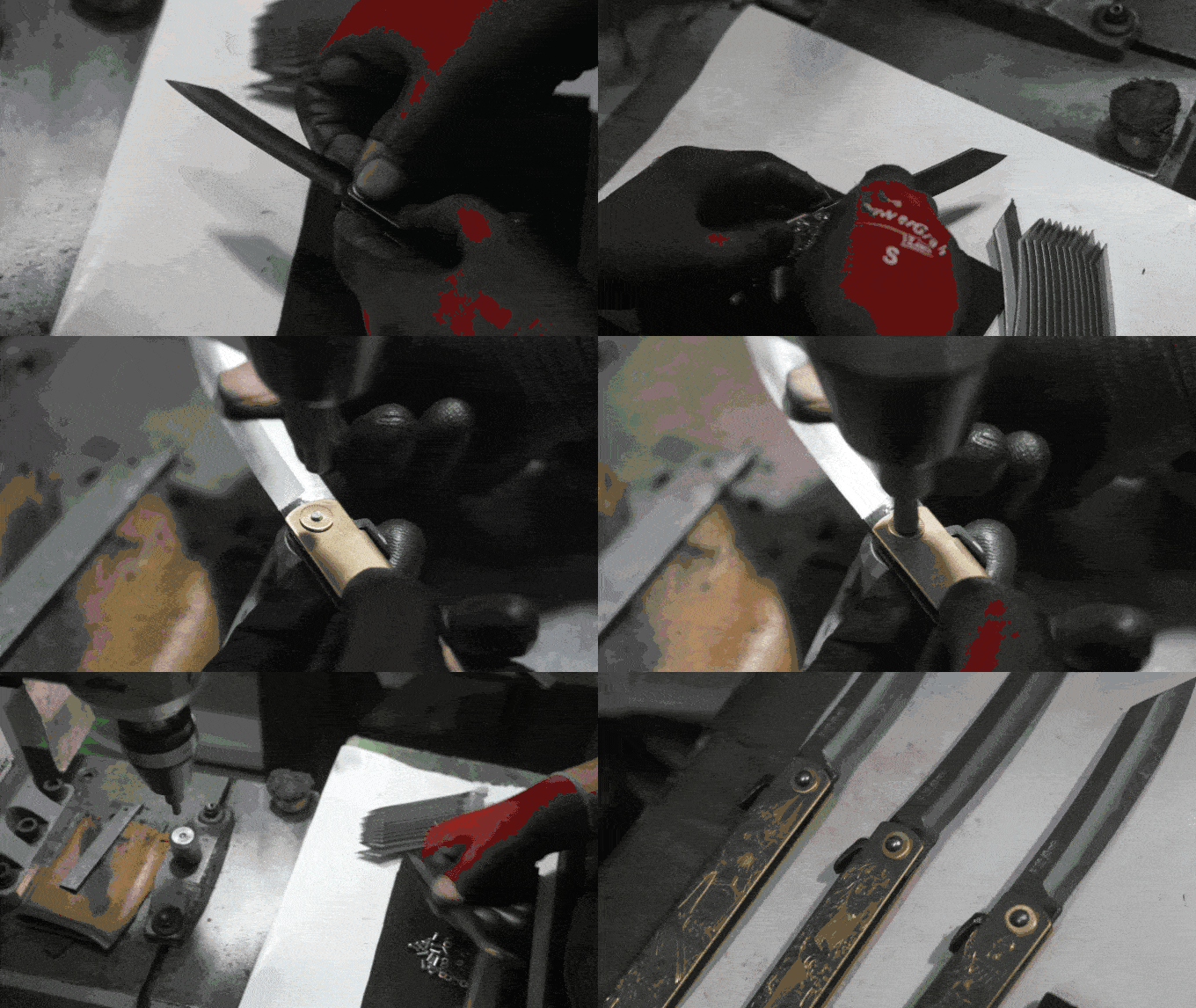
Correcting the edge of the blade
The angle of the blade is precisely set, and any twisted or deformed parts are corrected to achieve balance.

Finishing & Sharpening
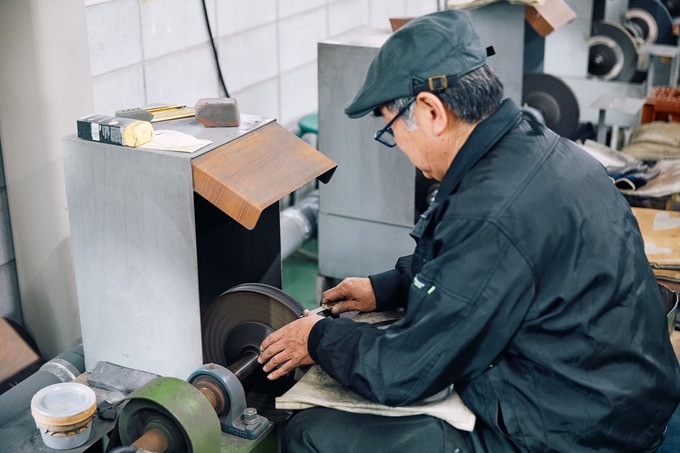

① Before using the whetstone, soak it in water for about 5 minutes.
② Hold the blade so that it faces your body, place your fingers on the blade, and push forward to sharpen.
③ Lift the spine of the blade to maintain an angle of about 15 degrees and sharpen the edge evenly.
④ Repeat the sharpening process equally on both the front and back sides of the blade.
Caution:
Apply pressure when pushing, and release pressure when pulling to move naturally.
If the whetstone starts to dry, add a little water as needed.
It must be sufficiently wet to sharpen safely.


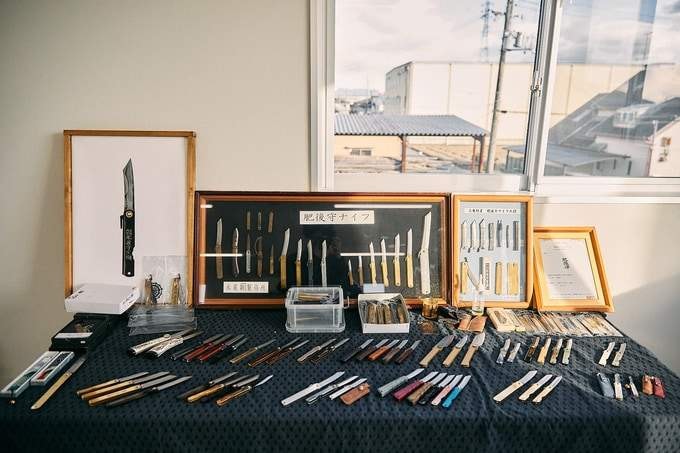
In Miki, the production of Higonokami knives began around 1894, about 120 years ago. The background for the development of knife making in this region dates back to the Sengoku period.
At that time, the Bessho clan was defending the castle, but during Oda Nobunaga's unification of Japan, Toyotomi Hideyoshi besieged the castle and cut off supplies, eventually leading to its fall.
After the castle and village were destroyed, many carpenters and artisans gathered here for reconstruction.
During the rebuilding process, the demand for various tools greatly increased, and since there was already a group of blacksmiths making farming tools in the area, saws, planes, chisels, stonemason tools, small blades, and various other tools began to be produced in Miki.
After the village was reestablished, many carpenters traveled across the country in search of work, leading to the formation of wholesalers who distributed tools made in Miki nationwide. This tradition of distribution continues to this day.
Meanwhile, a knife imported from Kagoshima (some say Kumamoto) became the origin of the Higonokami, and later, the Murakami and Nagao families devised the 'Chigiri' (lever-type structure) that allowed the blade and handle to fold together. Through continuous technological advancement and refinement, the Higonokami knife as we know it today was perfected.

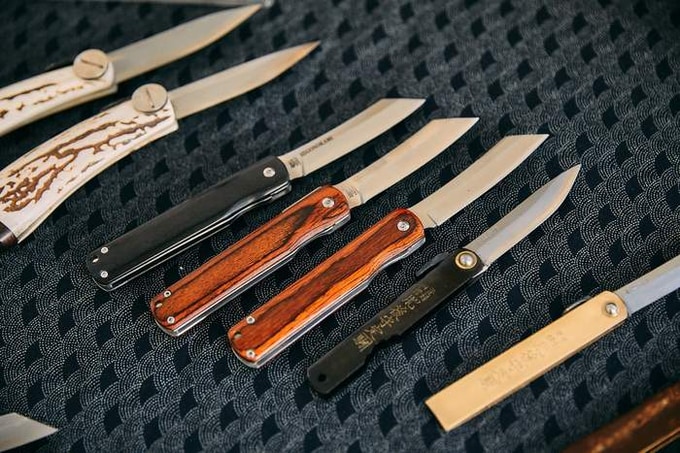
As the Higonokami knife gained popularity, imitations and counterfeit products have increased not only in Japan but also worldwide. These fake products often lack cutting power and durability, and since the name 'Higonokami' is currently a trademark that only Nagao Kanekoma Factory can officially use, unauthorized use of this name constitutes trademark infringement by law.
With a 130-year tradition, Nagao Kanekoma Factory is the last successor preserving the authenticity of the Higonokami, and has worked to protect and develop this precious heritage. In the future, we plan to take on new product development through platforms like Wadiz, and we hope buyers will join us in protecting the genuine brand.
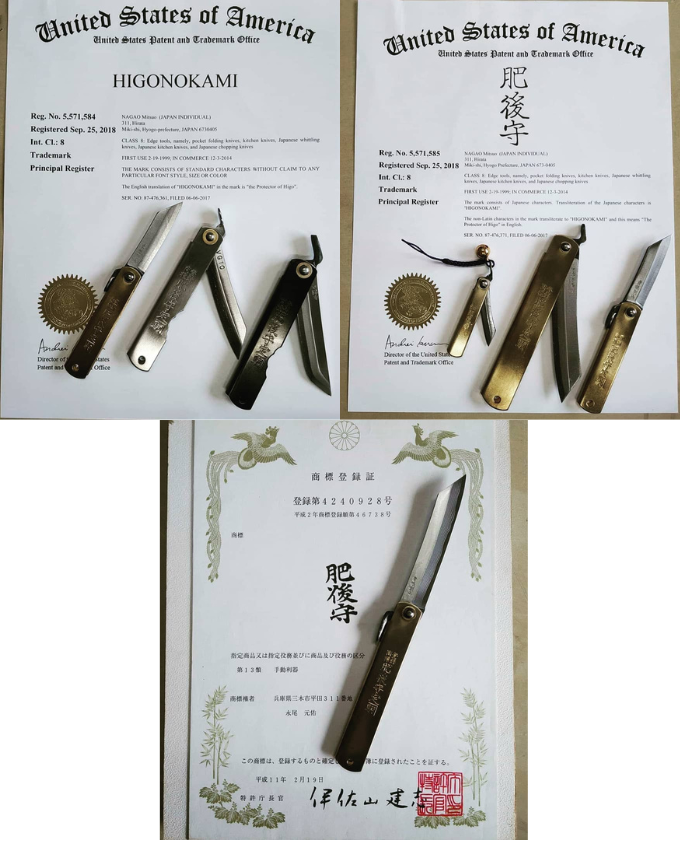
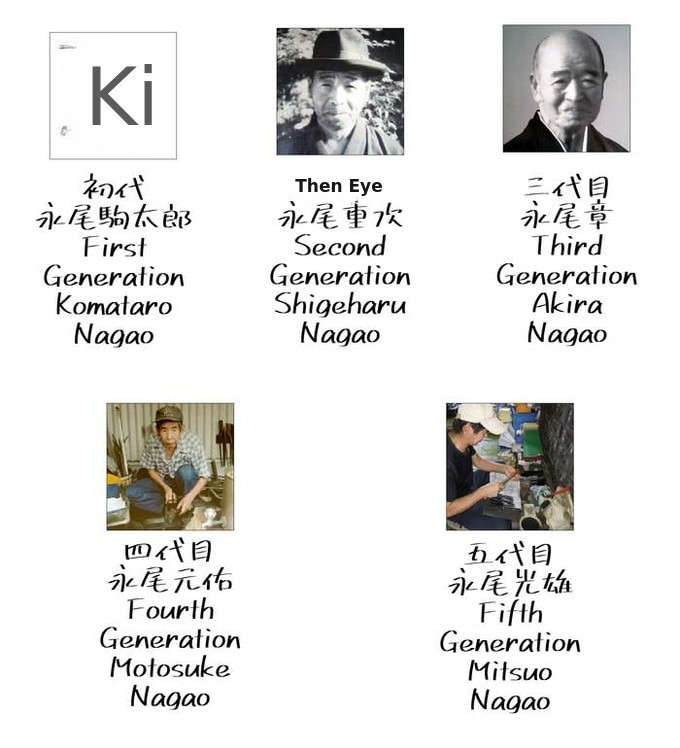
Since its founding in 1894 (Meiji 27) in Mikishi Hirata, the traditional Higonokami knife-making techniques have been passed down through five generations and production continues to this day.
At the peak of Higonokami's popularity, about 40 manufacturers with production rights were registered, and more than 200 artisans were active, enjoying great prosperity. However, as counterfeits and low-quality products began to circulate in the market, the name 'Higonokami' was officially registered as a trademark in 1910 (Meiji 43). After that, only manufacturers belonging to the association could use this name.
With changes in the times, industrial structure, and demand, many companies disappeared, and now only Nagao Kanekoma Factory remains as the official producer maintaining the trademark rights for Higonokami.
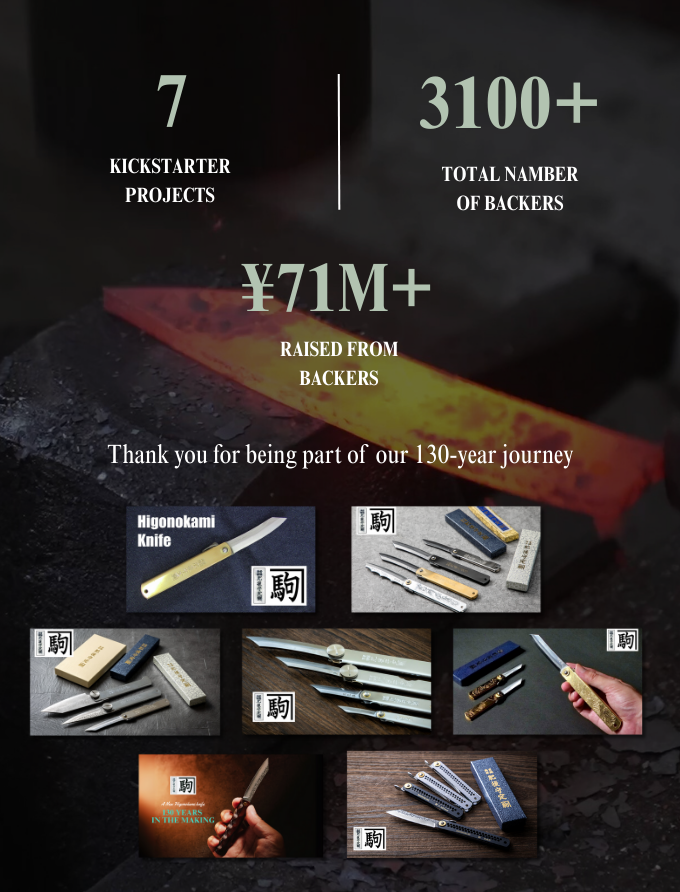
While participating in an exhibition in Cologne, Germany, the product was introduced by a French professional media outlet, gaining worldwide attention. Since then, various crowdfunding projects have showcased new forms of the Higonokami knife, once again attracting enthusiasts. Currently, there is steady demand both domestically and internationally, with a waiting period of about two years after production.
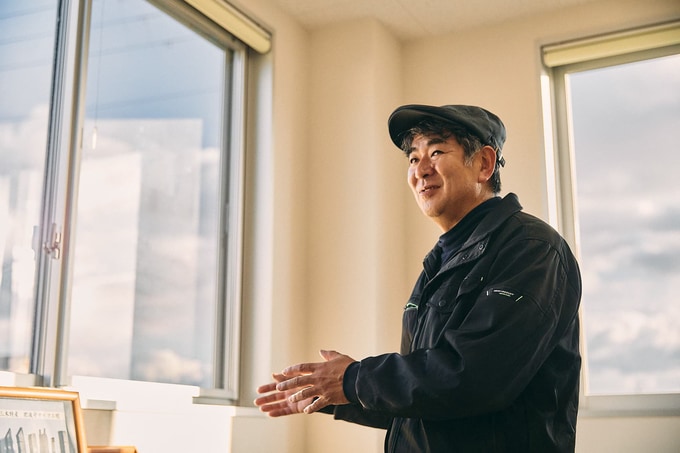
Fifth-generation artisan: Mitsuo Nagao (永尾光雄)
As the fifth-generation artisan, Mitsuo Nagao is dedicated to creating new Higonokami knives that combine tradition with creative design. Based on his philosophy that "a single knife can handle various tasks, and its range of use depends on the user's imagination," he hopes users will utilize the knife more freely.

Chie「血ゑ」 (Chie '血ゑ')
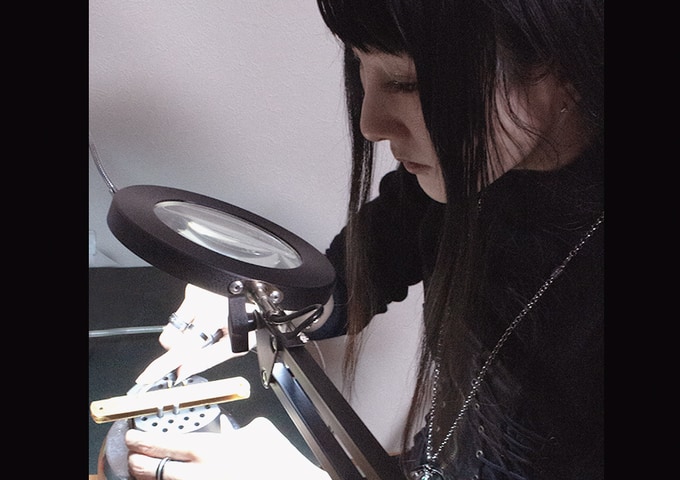
As a sculptor, I create works that encompass both Western styles and traditional Japanese printmaking techniques. I also collaborate with blacksmiths in Mikishi to produce unique blades that harmonize tradition and modern sensibility.
Every piece is engraved with care, stroke by stroke, as if breathing life into the work. My goal is not to let the knife remain a mere tool, but to elevate it into something with special meaning for its owner.
https://www.instagram.com/chie_abyssdesign/

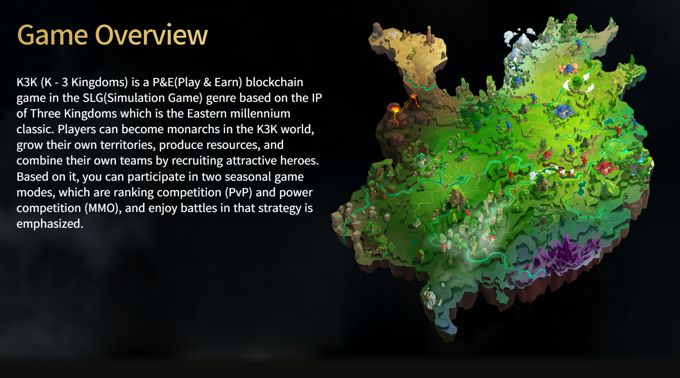
K-3 Kingdoms is a company developing blockchain-based games, and is presenting the mobile simulation game K3K, set in the era of the Three Kingdoms of ancient China.
This game is highly rated for its intuitive interface, excellent graphics, and immersive gameplay. Unlike existing blockchain games, it is easily accessible via the Google Play Store. Players can command about 100 generals, participate in various battles, and enjoy managing territories.
In upcoming events, K3K token rewards will also be provided, so those interested are encouraged to participate.
https://x.com/K3K_Official

Yoshinobu Fujimoto
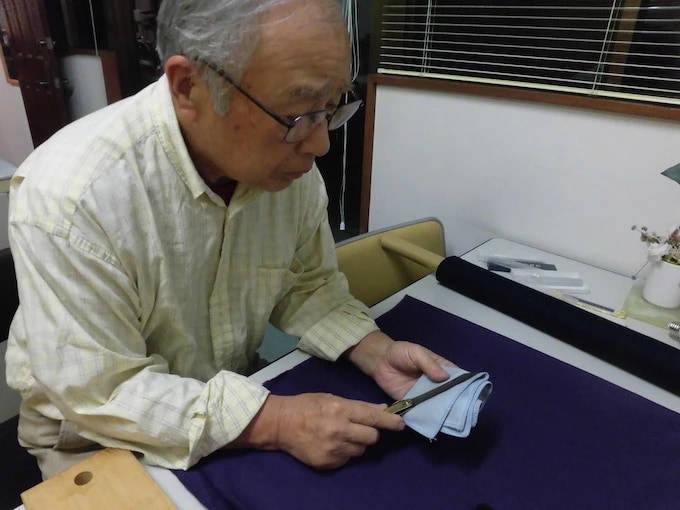
Following in the footsteps of his blacksmith father, he began his career in manufacturing by producing saws and tools. For over 60 years, he has participated in the development of a wide range of products, including electric mini circular saws, woodworking saw blades, metalworking tools, new construction materials, and products related to plastic and aluminum. In particular, the replaceable woodworking saw blade using Hitachi's Ginkami steel gained great popularity for its performance, even being able to cut through railroad tracks.
Based on his development experience in Mikishi, he expanded his business overseas, engaging in the development and distribution of various global products such as sensor lighting in Taiwan, gardening equipment and outdoor buggies in Israel, drill sharpeners in the UK, electric drills in Germany, and utility carts in the US. At the same time, he consistently introduced his own brand products, including multi-purpose power tools, power routers, electric grinders, solar sensor lighting series, electric snow blowers, hobby grinders, Istone minerals, and lawn trimmers.
Inspired by the COVID-19 pandemic, I returned to my roots with a desire to contribute to the local industry and to Miki, embarking on a new challenge. About six years ago, when we launched the Higonokami Sadamitsu, it received an enthusiastic response from enthusiasts, resulting in a waiting list of over six months. However, as its popularity grew, so did the number of counterfeits, so we have been continuously promoting the brand in Europe, the United States, Asia, and other regions to protect genuine products and provide accurate information.
Currently, some models have increased in value as collectibles, leading to waiting periods of up to two years. In response, we are focusing on developing a lineup of Higonokami knives that can be used safely in everyday life, such as large screw-fastened models made with VG10 steel, known for its excellent sharpness and durability.
For this project, Fujimoto of Alpha Industry is honored to participate as a representative of Mitsuo Nagao, the fifth-generation craftsman of the Nagao Kanekoma Factory, which boasts a 130-year tradition. We will continue to introduce our products with responsibility and dedication, and we deeply appreciate your interest and support.

The project is led by Guknaecheot.com Co., Ltd., introducing Japanese artisan works to Korea.