 NNDD
NNDD

Haven't you ever had thoughts like this?
"How did I live as a person today?"
There are not many people who can answer this question right away.
We certainly live fiercely, but when we look back, each day seems indistinguishable from the next,
and it is often summed up with a single phrase: "I was just busy."
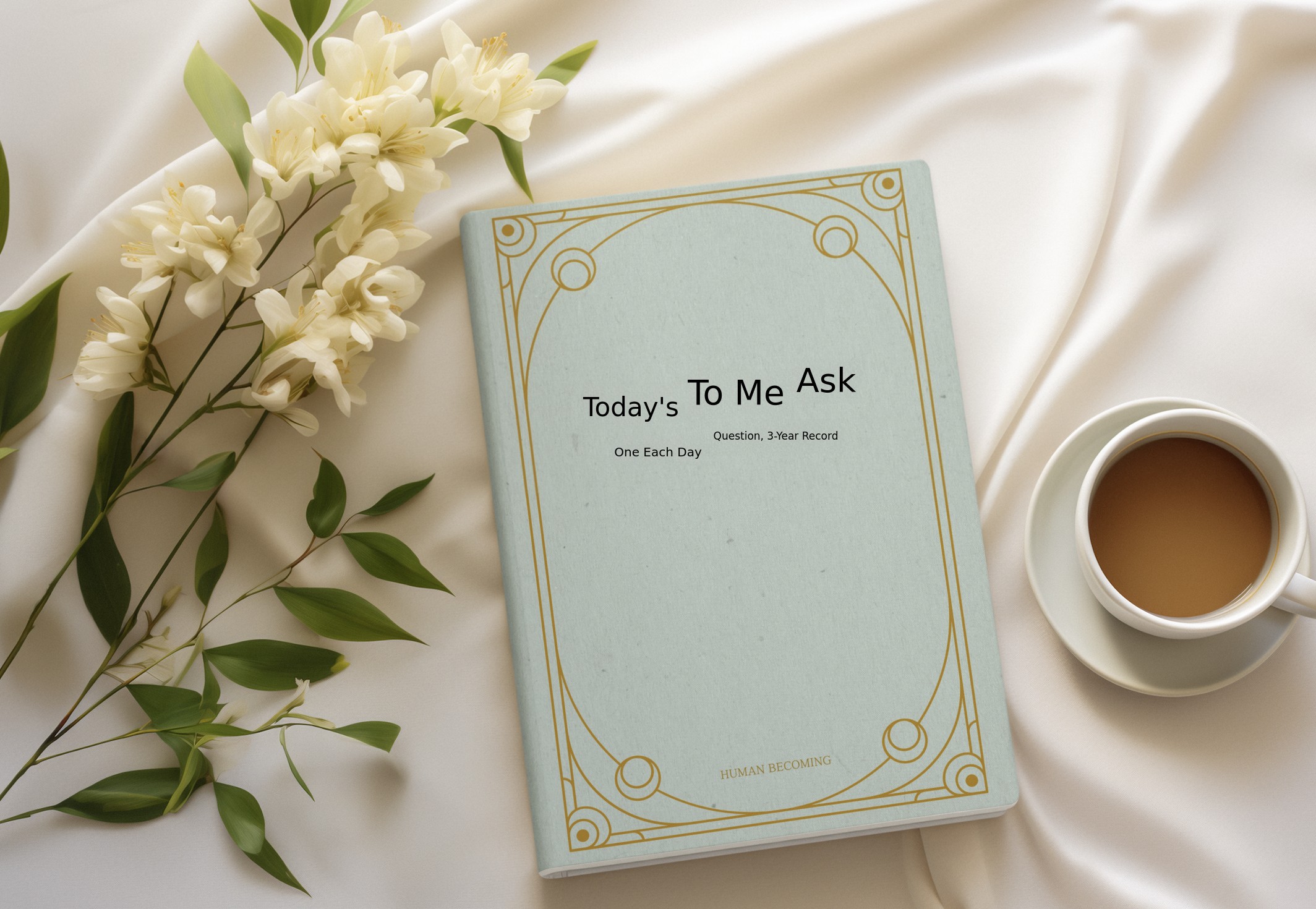
That is why this book,offers you 365 questions and guides you to record your answers to the same questions repeatedly for three years, helping you along the way.
- In the first year, you write about yourself just as you are now.
- In the second year, you compare who you were then to who you are now.
- In the third year, you can see at a glance the trajectory of your thoughts and feelings over the past three years.
The moment you close this journal after three years,
this book is no longer just a diary,but a small autobiography capturing the changes of a person called 'me',and that is what it becomes.
Why are questions and records so powerful?
"Asking questions and writing them down" often sounds like a personal preference.
However, this simple habit has been,a psychological and neuroscientific intervention validated by hundreds of research papers over the past 40 years,and that is a fact.
Expressive writing, which began with an experiment in 1986
In 1986, James Pennebaker, a psychologist at the University of Texas at Austin, conducted an experiment.
- He divided 46 college students into four groups.
- For four days, each group wrote for 15 minutes a day.
One group wrote about trivial things, such as "what they did today."
Another group honestly wrote about the most difficult experiences in their lives.
The results were surprising.Students who wrote about their difficult experiences visited the hospital less frequently over the next six months, showed improved immune function, and had lower depression and anxiety scores.
* This study was published in the Journal of Abnormal Psychology
under the title "Confronting a Traumatic Event: Toward an Understanding of Inhibition and Disease."
Afterward, it opened a new field of research called "Expressive Writing."
What 40 years and over 400 follow-up studies have shown
Since Pennebaker's research, more than 400 follow-up studies have been conducted worldwide. Among them, several studies have commonly shown the following changes.
Reduction in depression and anxiety
- In a 2006 study by Gortner, Rude, and Pennebaker (published in Behavior Therapy), college students with depressive tendencies engaged in expressive writing for four days,
and showed a significant reduction in depressive symptoms even after six months. This was the result.
- In a 2006 study by Gortner, Rude, and Pennebaker (published in Behavior Therapy), college students with depressive tendencies engaged in expressive writing for four days,
Improvement in physical health and immune function
- Some studies found that groups who organized their emotions and thoughts in writingshowed improved immune system indicators Or,Reported a decrease in the number of hospital visits. was observed.
Stress management and improved resilience.
- When you turn your emotions into an 'understandable story' through repeated writing,
the brain begins to see the same event differently,and resilience to stress increases. These results have been consistently observed.
- When you turn your emotions into an 'understandable story' through repeated writing,
In other words, 'asking questions and writing them down'
is not just a sentimental hobby,
but a psychological and neuroscientific intervention verified by hundreds of papers over the past 40 years. It is.
What makes this book unique: 'Questions + 3-year repetition structure'
Many studies focus on short-term interventions like 'writing for 15 minutes a day over several days.'
I have added 'questions' and 'a period of three years' to this.
- One per day,I present just one question.
- And you will encounter that question again,on the same date for three consecutive years.
In the first year, you may simply write about 'yourself as you are now,'
In the second year, you find yourself comparing, thinking, "This is how I wrote last year."
In the third year, you discover, "I've changed like this in the meantime."
The answers accumulated over three years eventually become,
a long answer to the questions, "What kind of person am I, what do I value, what do I fear, and what did I hope for?",
in other words,my own autobiography.
The one habit chosen by the busiest people in the world
It is not only researchers who talk about this.
If there is one habit that people who live the busiest lives and have to make the most decisions in the world commonly mention, it isrecording.
Oprah Winfrey has kept a journal since she was 15.
She says this habit is "the single most important habit I have maintained."She says that the result of asking herself questions for a long time is the 'Oprah' we know today.Nelson Mandela spent 27 years in Robben Island prison,
Small moments when I could drink tea, like seeing a flock of ducks by the prison wall,
I recorded even the trivial scenes.
He wrote this in a letter."The simple act of writing my thoughts and expressing my feelings brings me a certain joy and satisfaction."Thomas Edison left behind more than 3,500 diaries and 5 million pages of records in his lifetime.
For him, writing was not a warehouse of ideas,but a tool to examine his own thoughts.Emma Watson says she keeps ten journals at a time and writes every night before going to sleep.
"The moment I see my thoughts on paper, I become much less afraid."
After a four-year hiatus, she cites "journaling with questions" as the habit that played the biggest role in her recovery.In addition,Warren Buffett, Richard Branson, Barack Obama, and Michelle Obama have
on several occasionsspoken about the power of journaling publicly.
TheyNot because I succeeded,
But because I did not lose my way while writing, I was able to reach where I am now. He says.
What this journal adds: the variable of 'three years'.
The past 40 years of research have confirmed the value of "writing about your emotions." However, most studies focus on3 to 4 days, 15 minutes a day likeshort-term writing sessions.
〈Ask Myself Today〉 adds one more thing.
That is,time, andrepetition.
- One per day,We give you just one question.
- That question,today / one year later / two years later you will encounter three times.
In the first year, you can simply start by writing about your current self.
In the second year, you read what you wrote a year ago and realize, "I've changed like this over time."
In the third year, as you turn the pages with three answers to the same question side by side,
the trajectory of your life and thoughts becomes visible at a glance.
Researchers measured the 'before and after writing' in numbers.
This journal allows you to visually seethe very changes that occurred between those numbers, with your own eyes.
After three years, when you close this book,
this is not an autobiography written by someone else,
but "365 questions I asked myself"
and "1,095 answers" that complete your own autobiography, making it truly yours.
Recommended for these people:
- Those who feel that each day passes by busily, leaving no time to reflect on who they truly are.
- Those who have tried to keep a diary several times but couldn't continue because they felt lost about what and how to write.
- Those who want to visually confirm how their current worries and emotions will change in the future.
- Those who want to slowly experience the effects of 'expressive writing' as described in psychology and neuroscience in their daily lives.
- Those who want to leave behind their own autobiography after three years through a long-term self-reflection project.
If you have long held the desire to "someday write something," this journal will be the first step to turning that wish into "10–15 minutes of real writing each day."
Here are some examples of the questions.
"If I were not afraid of failure, what could I try right now?"
"Will the choice I made today be something I am not ashamed of in ten years?"
"Is the goal I am obsessed with right now truly 'mine'?"
"If I let go of both money and fame, would I still do this work?"
Maker Introduction
<Asking Myself Today> is
based on my personal journaling habits and
the "life-changing questions" of 100 global leaders
coming together in a single book as an experiment.
For someone, this journal may become
a brief ritual to wrap up the day,
a small companion to help endure tough times,
and in three years, a quiet autobiography showing "what kind of person I have lived as."
This is also why I am introducing this project on Wadiz for the first time.
In this place where people are willing to invest their time in meaningful endeavors,
I wanted to experiment with the age-old habits of questioning and journaling,
together with the life questions of global leaders.
If right now,
"Is it really okay as it is now?"
If the question, "What kind of life do I want to live?" lingers in your heart,
Together with <Ask Myself Today>,
We invite you to slowly, but steadily, write down your own questions and answers.