 Mystery Research Institute
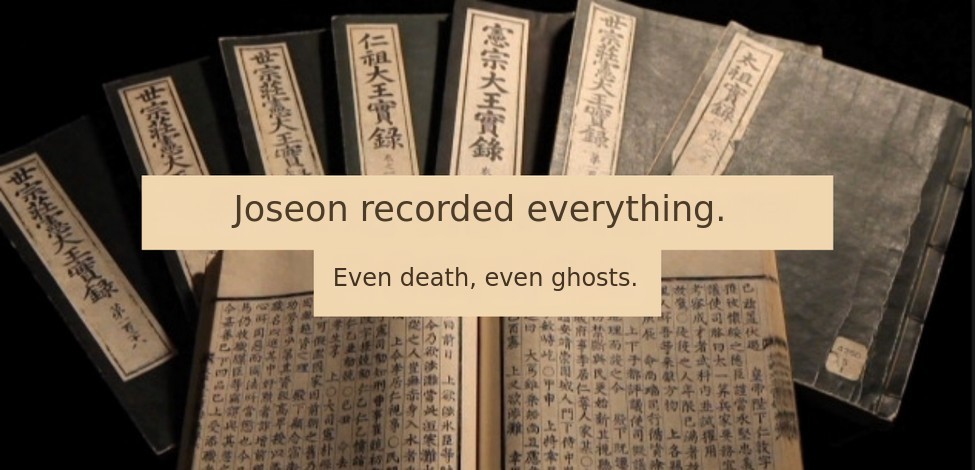
Within the records left by a 500-year dynasty, there are things that textbooks do not teach. The names of those who died unjustly, eyewitness accounts of vengeful spirits wandering the palace at night, and records of people who lost their lives at the hands of those closest to them. Joseon meticulously documented all of these things.
『Heumheum Sinseo』 contains stories of those who confessed to murders they did not commit because they could not endure torture.『Simniryok』 contains records of people whose innocence was revealed only after their execution.『Eou Yadam』 contains the testimony of a night watchman who witnessed a group of goblins marching through the heart of Hanyang every night.『Cheonggu Yadam』 contains records of a haunted house where disasters recurred every time the owner changed over generations.
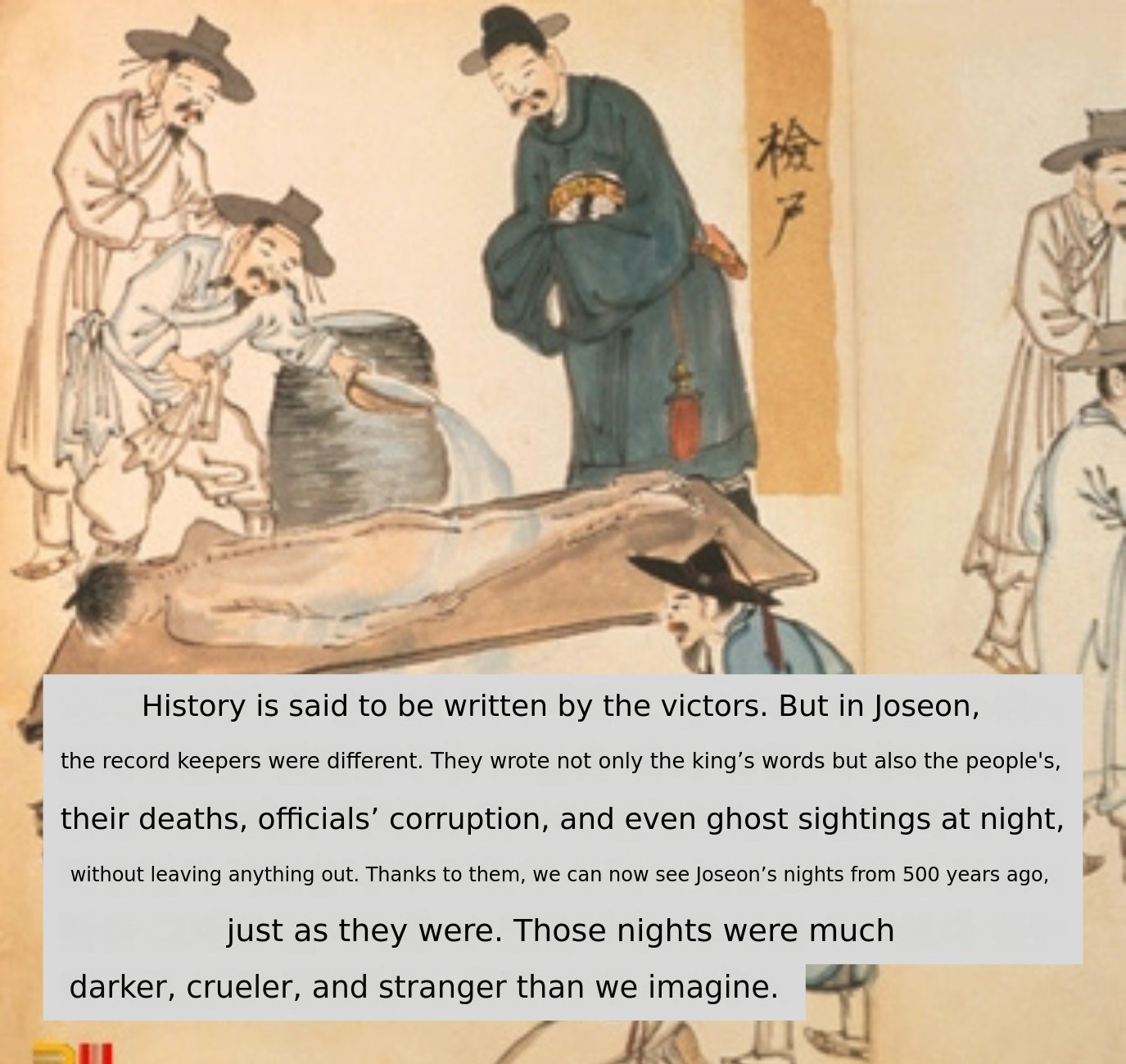
Case 1. Why did the wife poison her husband's meal?
A real poisoning case recorded in 『Heumheum Sinseo』 and 『Simniryok』.
In the early 1800s, a man in his 30s suddenly died in a village in Gyeonggi Province. The neighbors assumed it was due to his chronic illness. The body was quickly taken care of and the funeral was held. No one suspected anything. That is, until it was discovered that his wife had poisoned his meal.
The case was revealed purely by chance. A month later, another suspicious death occurred in the same village, and a coroner dispatched from the local office examined both cases together and noticed something strange. Upon re-examining the first victim's body, the coroner found that his fingernails and toenails had turned black. This was a typical sign of poisoning recorded in 『Muwonrok』.
The coroner immediately summoned the wife for interrogation. At first, she strongly denied it. However, as witnesses were called in one by one for face-to-face questioning, following the interrogation methods recorded in 『Chuan Geupgukan』, cracks began to appear. One neighbor testified that the wife had stayed alone in the kitchen for a long time on the day she prepared her husband's meal, and another testified that the husband suddenly complained of stomach pain right after eating.
Eventually, the wife confessed. The poison was a medicinal herb obtained from a nearby pharmacy. She said she collected small amounts of herbs known to be highly toxic and mixed them into the rice over several days. She knew that using a large amount at once would immediately arouse suspicion.
When asked why she killed him, the wife remained silent for a long time. Then she spoke. She said she was beaten every day. That he would pick up a club whenever he drank. That she was driven away when she went to the authorities for help. That she tried to run away but had nowhere to go.
In 『Heumheum Sinseo』, Jeong Yak-yong analyzed cases of this type and wrote as follows: Women who could not wield a knife chose poison. And behind that choice were always things that Joseon did not allow women.
The wife was sentenced to death. Poisoning was classified as one of the most serious forms of murder in Joseon. However, Jeong Yak-yong questioned this verdict. Joseon's law did not punish husbands who beat their wives every day, but sentenced wives who tried to escape that violence to death. 『Heumheum Sinseo』 recorded this injustice. And even 200 years later, that record still poses uncomfortable questions for us.
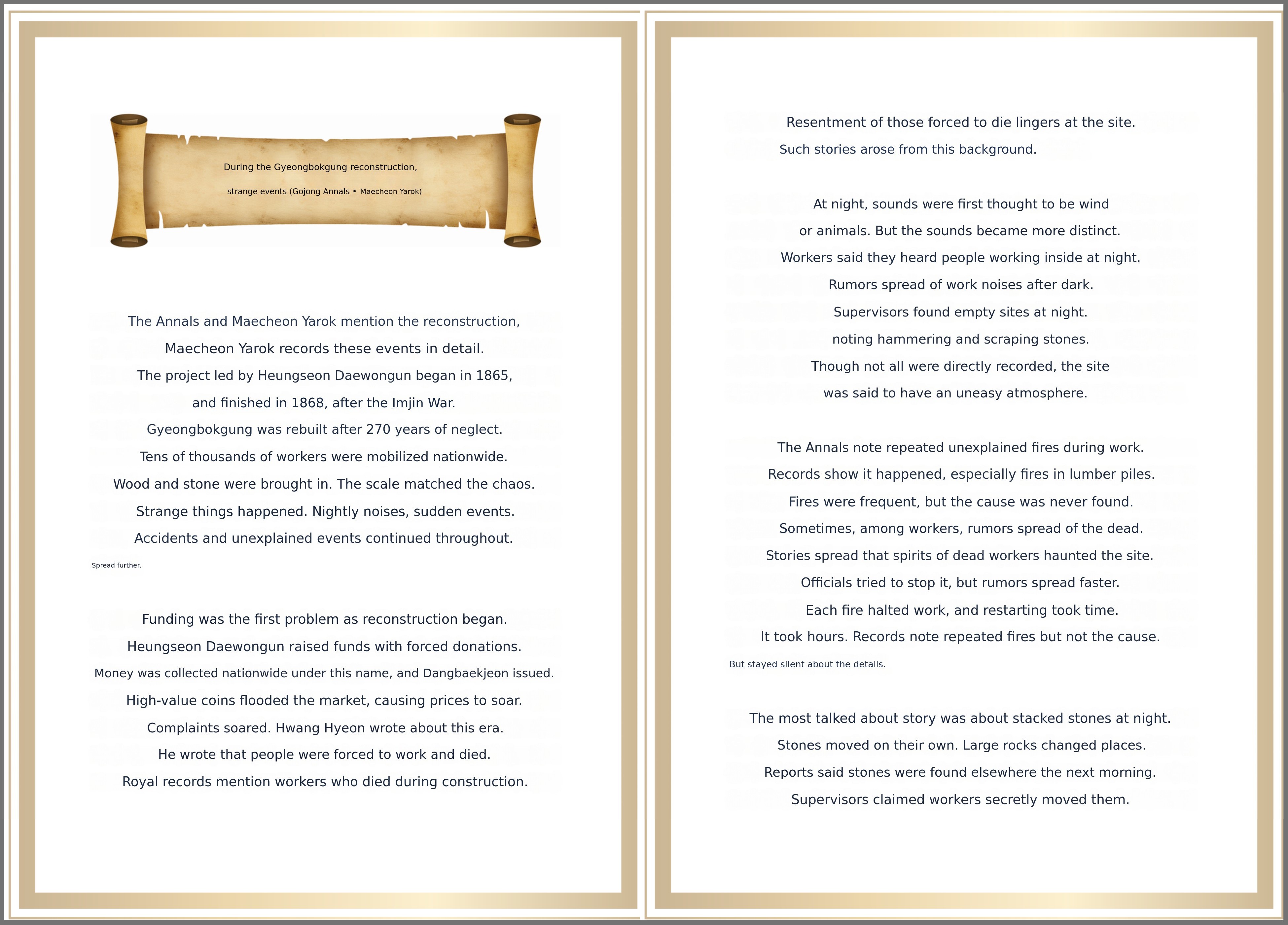
Case 2. The sound heard at the Gyeongbokgung reconstruction site
Actual strange phenomena recorded in the Annals of King Gojong and Maechon Yarok.
In 1865, Heungseon Daewongun ordered the reconstruction of Gyeongbokgung Palace, which had been left in ruins for nearly 270 years since the Imjin War. Tens of thousands of workers were mobilized from all over the country. The construction continued day and night. However, not long after the work began, strange things started to happen.
The workers returning from night shifts all said the same thing. They heard sounds from inside the construction site, in areas where no one was working. At first, they thought it was just the wind. But even on days when there was no wind at all, the sounds continued. The sound of hammers, stones being stacked, and sometimes something that sounded like a human voice.
Hwang Hyeon recorded the stories that circulated at the Gyeongbokgung construction site during this period in Maechon Yarok. The most talked-about story among the workers was that of a carpenter. One night, while finishing up work alone, the carpenter was found unconscious at his spot the next morning. After waking up, he said that something had been beside him all night. But he never said what it was. A few days later, the carpenter left the site and never returned.
There were also a series of unexplained accidents at the construction site. Scaffolding that had been fine collapsed, and stones that had been firmly fixed rolled off on their own. The workers whispered among themselves. They said that things accumulated on the land left in ruins for 270 years were interfering with the construction. That those who died in the fire during the Imjin War still had not left the place.
Heungseon Daewongun called a shaman to perform a ritual. The Annals of King Gojong record that various rituals were held during the reconstruction. Even Confucian officials, who usually rejected superstition, did not object to this decision. This meant that the atmosphere at the construction site was that unsettling.
After the ritual, the sounds stopped. The accidents decreased. The workers were relieved. But no one knew whether it was truly the effect of the ritual or just a coincidence. Maechon Yarok added a single line to this story: Even after the construction was finished, no one felt at ease in Gyeongbokgung at night.
Gyeongbokgung was completed in 1868. And 27 years after its completion, in 1895, Empress Myeongseong was assassinated there. It was the first tragedy to befall the palace rebuilt on land that had been in ruins for 270 years.
The night of Joseon did not end.
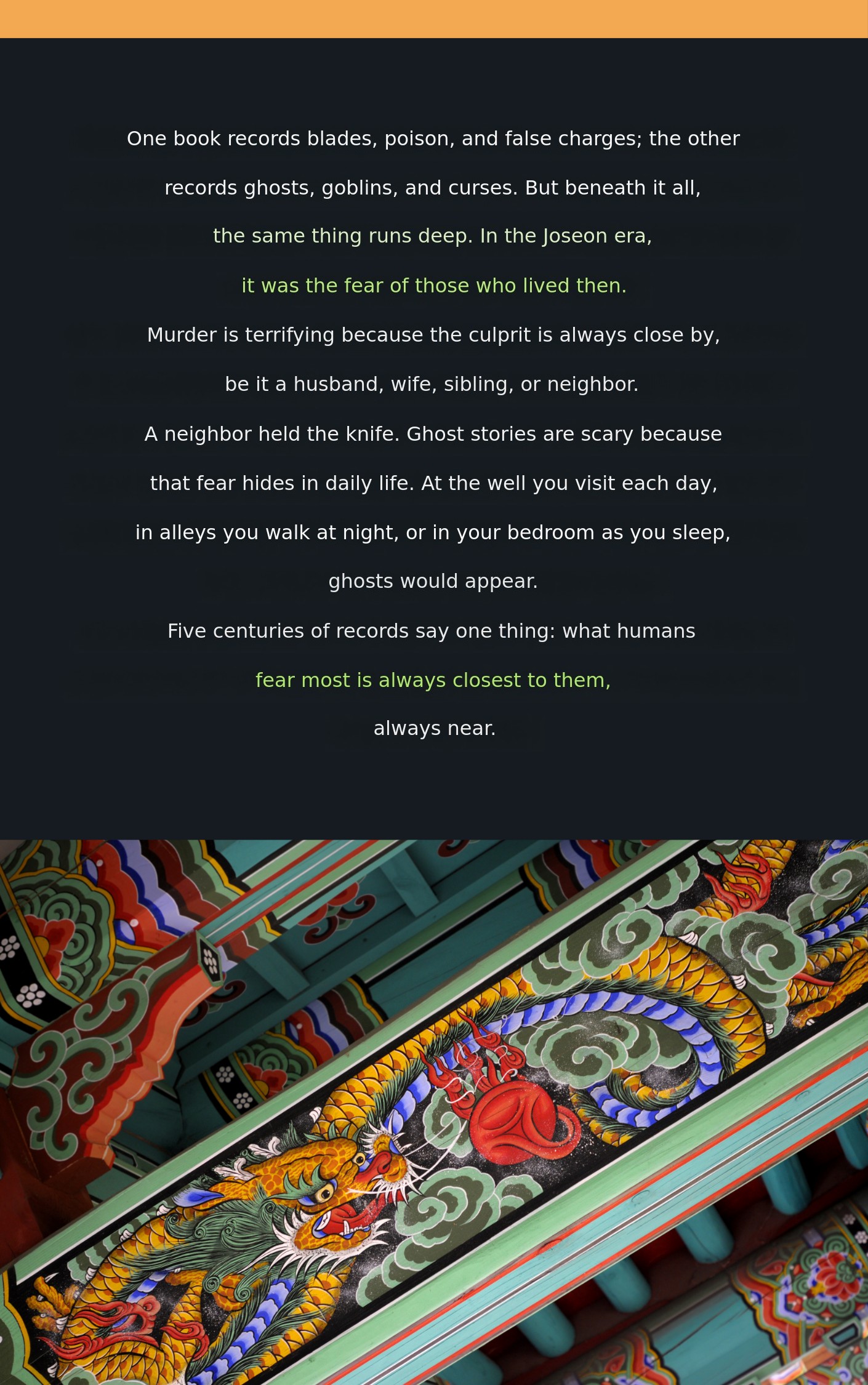
References and sources.
This was written based solely on facts recorded in actual documents such as Heumheum Sinseo, Simniryok, Eou Yadam, Cheonggu Yadam, Muwonrok, Chuan Geupgukan, Geoman, and Maechon Yarok.
Murder Edition. Preview.
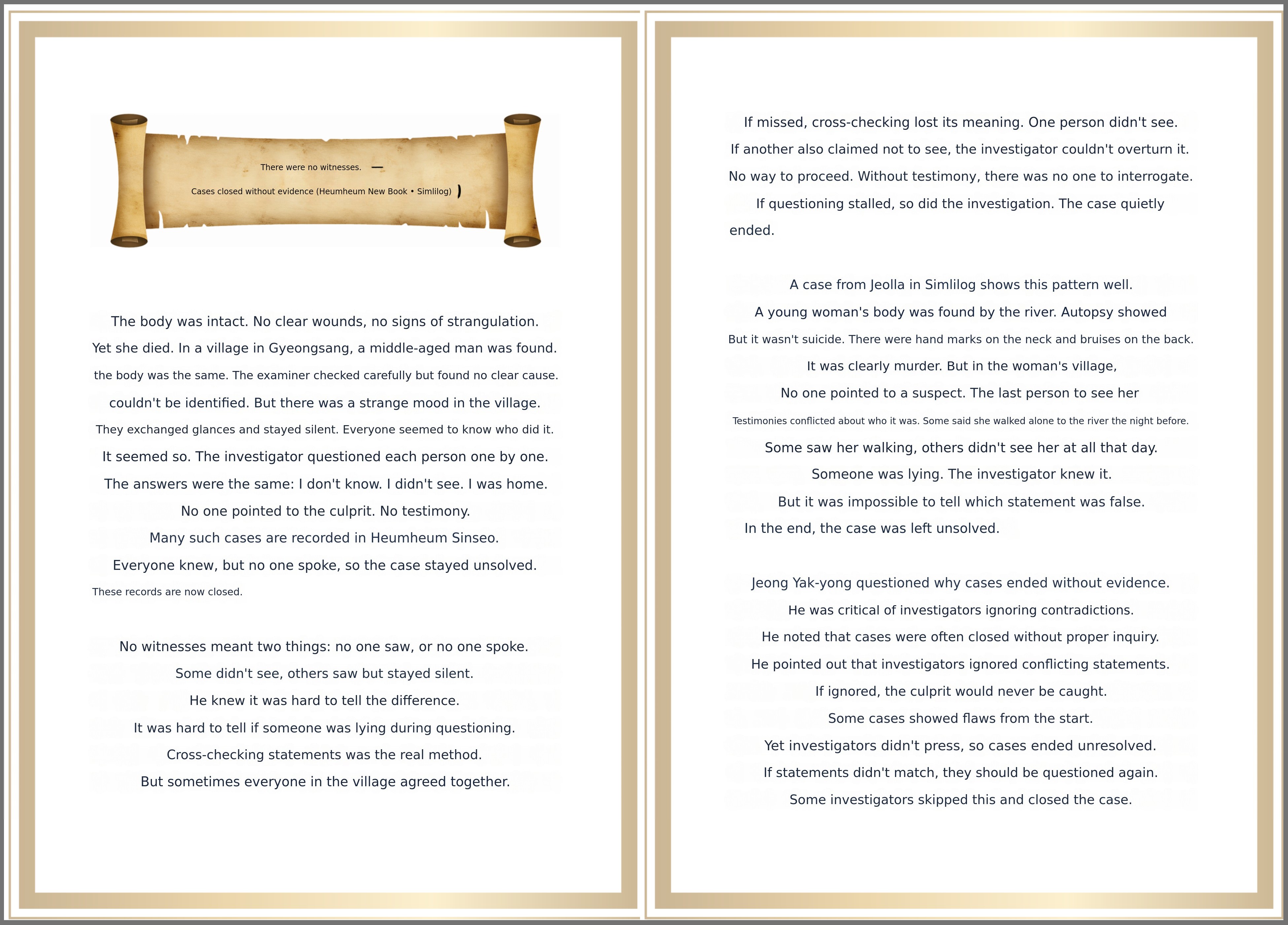
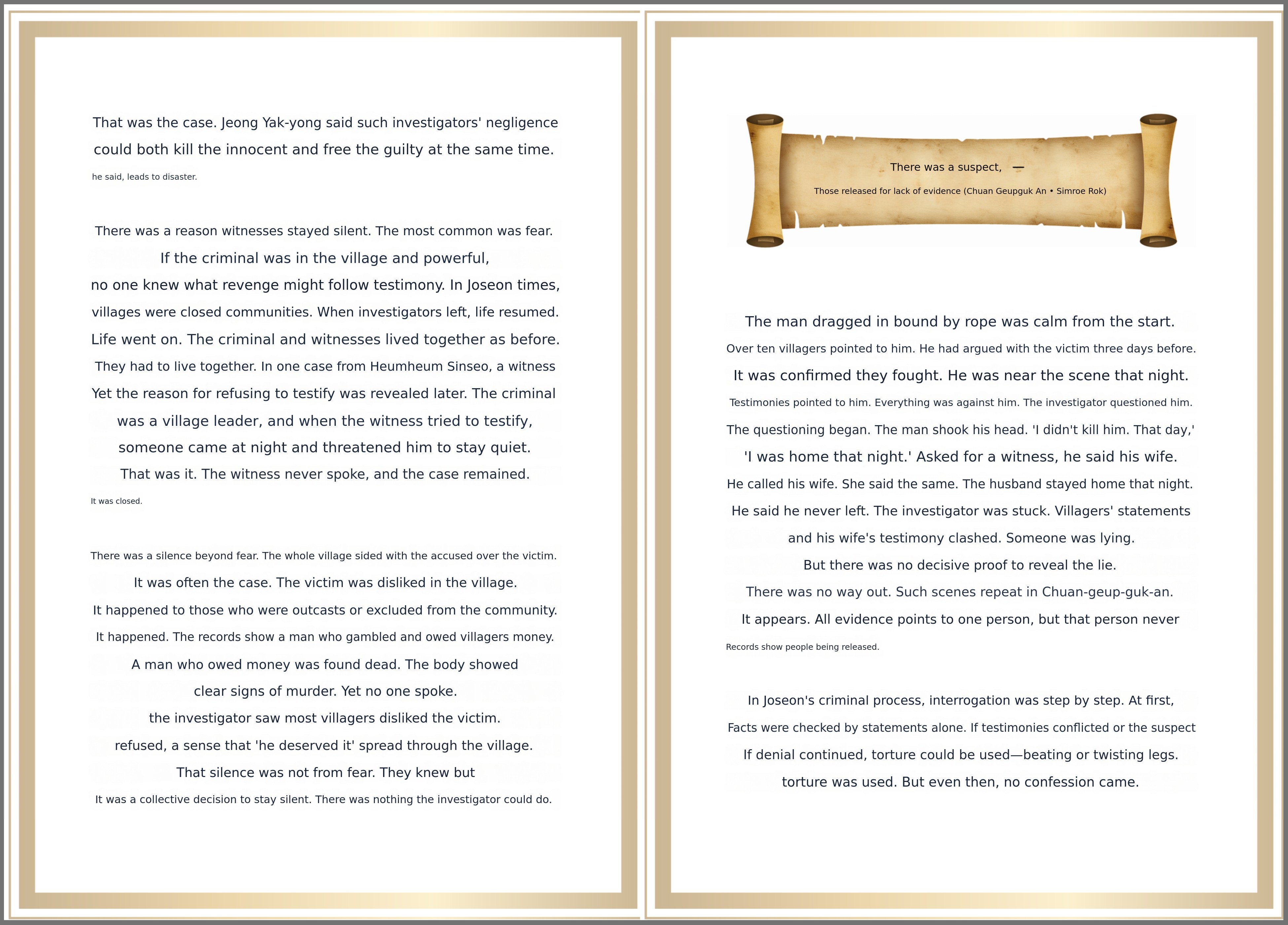
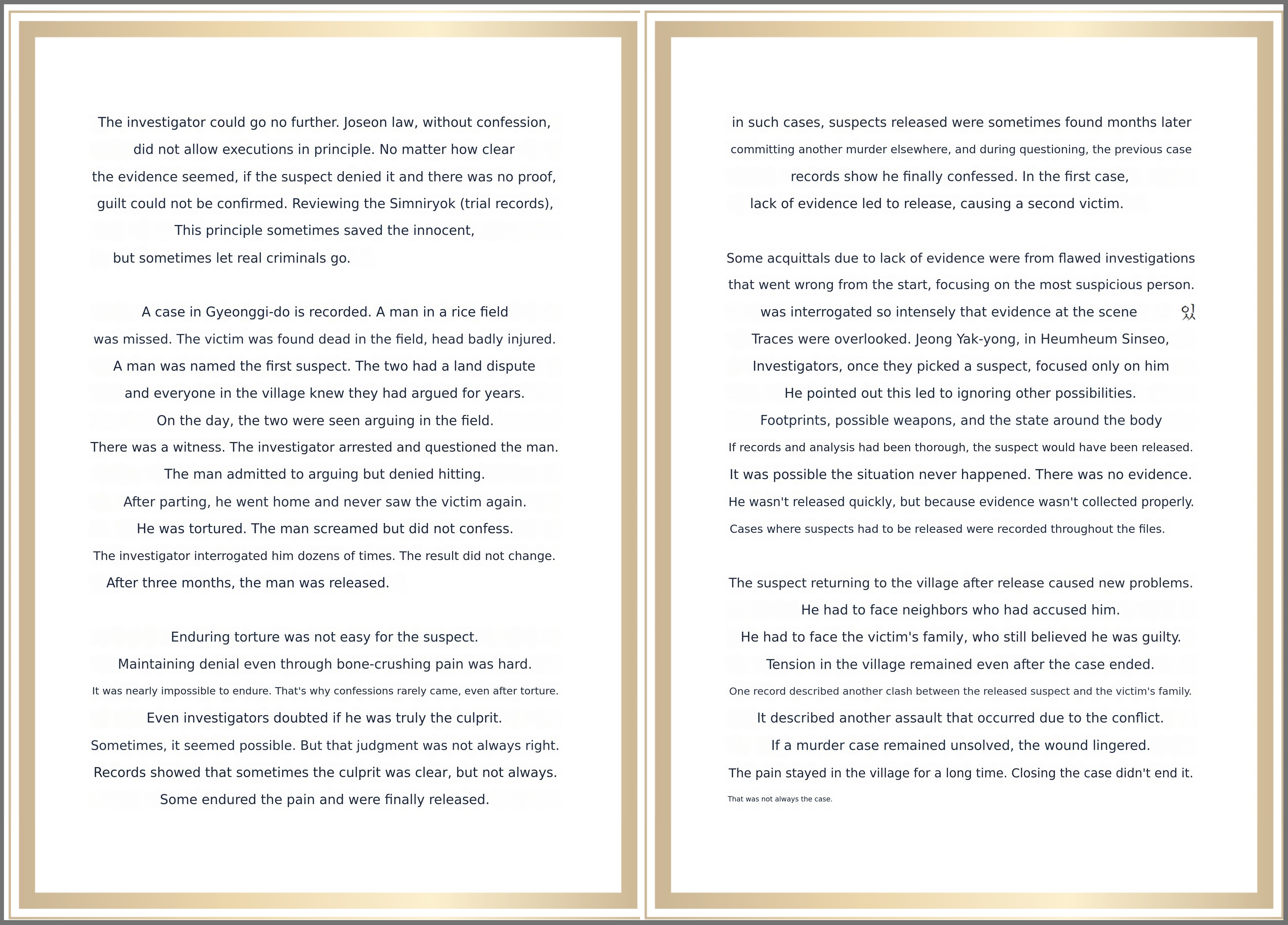
Murder Edition. Table of Contents.
Prologue. How did Joseon record murder?
- Joseon's official murder investigation procedure — from autopsy to verdict (Muwonrok, Heumheum Sinseo)
- Forensic science in Joseon — How corpses point to the culprit (Muwonrok)
- Preventing wrongful deaths — Why Jeong Yak-yong wrote Heumheum Sinseo (Preface to Heumheum Sinseo)
Chapter 1. Family kills family — Family murder.
- Wives who killed their husbands — Records from the Annals and Simniryok (Simniryok, Annals of the Joseon Dynasty)
- Husbands Who Killed Their Wives — The Most Frequently Recorded Type of Murder (Heumheum Sinseo·Simnilog)
- A Son Kills His Father — Actual Records of Filial Murder (Simnilog·Chuan Geupguk An)
- A Daughter Kills Her Mother — The Rarest Case of Filial Murder in the Records (Simnilog·Gaksadeungnok·Chuan Geupguk An)
- Murder Between Siblings — Tragedies Caused by Inheritance and Jealousy (Heumheum Sinseo·Simnilog)
- Daughter-in-law and Mother-in-law — Records of Family Conflict Escalating to Murder (Simnilog·Heumheum Sinseo)
- Murder Over a Concubine — Incidents Between the Legal Wife and the Concubine (Heumheum Sinseo·Simnilog)
- Parents Who Killed Their Children — Records of Infanticide in Joseon (Simnilog·Gaksadeungnok)
- Marriage Leading to Murder — Incidents Between Son-in-law and Father-in-law (Simnilog·Gaksadeungnok)
- Remarriage Leading to Murder — Incidents Between Children of the First Wife and the Second Wife (Heumheum Sinseo·Simnilog)
Chapter 2. Murder Over Money and Land — Homicides from Property Disputes
- Land Disputes Leading to Murder — Death Over a Plot of Land (Simnilog·Gaksadeungnok)
- Trying to Seize an Inheritance — Actual Records of Homicide from Inheritance Disputes (Heumheum Sinseo·Simnilog)
- If Debts Are Not Repaid — Records of Creditors Killing Debtors (Simnilog·Gaksadeungnok)
- Murder Among Merchants — Incidents on the Trade Route (Simnilog·Gaksadeungnok)
- Theft Leading to Murder — Records of Homicide Beginning with Theft (Heumheum Sinseo·Simnilog)
- Death Caused by Forgery and Fraud — Murders Related to Document Forgery (Chuan Geupguk An·Simnilog·Gaksadeungnok)
- Lending Money and Dying — Actual Records of Debtors Killing Creditors (Simnilog·Gaksadeungnok)
- Murder Over Cows and Horses — Deaths from Livestock Disputes (Simnilog·Gaksadeungnok)
- Gambling Debts Leading to Murder — Records of Homicide Related to Gambling (Simnilog·Chuan Geupguk An)
Chapter 3. Murder Created by Social Status — The Caste System and Homicide
- A slave kills the master — Joseon's greatest taboo (Chuan Geupguk An·Simnireok)
- A master kills a slave — The boundary between legality and illegality (Simnireok·Gaksadeungnok)
- A yangban kills a commoner — Murder using social status (Simnireok·Heumheum Sinseo)
- A commoner kills a yangban — The fear of status reversal (Chuan Geupguk An·Simnireok)
- An official kills the people — Actual records of murder by abuse of power (Secret Inspector Reports·Simnireok·Gaksadeungnok)
- Murder at the boundaries of status — Cases entangled with chungin, seo-eol, and commoners (Simnireok·Gaksadeungnok)
- Murder committed by runaway slaves — Records of murders involving escaped slaves (Chuan Geupguk An·Simnireok)
- Murder caused by status deception — Tragedies created by status disguise (Chuan Geupguk An·Simnireok)
- Murder surrounding gisaeng — Murder cases created by the government gisaeng system (Simnireok·Gaksadeungnok)
Chapter 4. The art of poisoning — Poisoning cases
- Poisons of Joseon — Types of poisons actually used and autopsy methods (Muwonrok·Heumheum Sinseo)
- Poison added to food — Actual records of civilian poisoning cases (Simnireok·Geoman)
- Poisoning or natural death — Records of suspicious deaths that were hard to distinguish (Heumheum Sinseo·Geoman)
- Poison in the pharmacy — Poisoning cases using herbal medicine (Muwonrok·Simnireok·Geoman)
- Why women poisoned — Actual case records of female poisoners (Heumheum Sinseo·Simnireok)
- Cases ending in suspicion of poisoning — Unsolved records due to limitations of autopsy (Simnireok·Geoman)
- Poison added to alcohol — Poisoning cases at banquets (Simnireok·Geoman)
- Cases of poisoning children — Actual records of child poisoning (Simnireok·Gaksadeungnok·Geoman)
- How poisoners were caught — Actual investigation records of Joseon coroners tracking poisoners (Muwonrok·Heumheum Sinseo)
Chapter 5. Never caught — Unsolved murder cases
- The culprit disappeared — Records of unsolved murder cases in Joseon (Simniryok·Gaksadeungrok)
- There were no witnesses — Cases closed without evidence (Heumheumsinseo·Simniryok)
- There were suspects, but — Those released due to insufficient evidence (Chuan-geupgukan·Simniryok)
- No body was found — The boundary between disappearance and murder (Simniryok·Gaksadeungrok)
- The investigation was covered up — Unsolved cases involving power (Secret Inspector Reports·Simniryok)
- There were two culprits — Cases where the accomplice relationship was never revealed (Chuan-geupgukan·Simniryok)
- The suspect died — Cases closed with the death of the suspect during investigation (Simniryok·Gaksadeungrok)
- The entire village remained silent — Unsolved cases suspected of collective cover-up (Secret Inspector Reports·Simniryok)
- Murder or suspicious death? — Cases closed without ever revealing the cause (Simniryok·Gaksadeungrok)
Chapter 6. False accusations — Misjudgments and wrongful charges
- Those falsely accused — Unjust cases recorded by Jeong Yak-yong (Heumheumsinseo)
- False confessions from torture — Records questioning the credibility of confessions (Heumheumsinseo·Chuan-geupgukan)
- Witnesses lied — Cases overturned by perjury (Heumheumsinseo·Simniryok)
- The autopsy was wrong — Records of misjudgments caused by faulty examinations (Heumheumsinseo·Muwonrok)
- Verdicts overturned by retrial — Cases personally corrected by King Jeongjo (Simniryok)
- Truth revealed after execution — Records of injustice discovered too late (Heumheumsinseo·Simniryok)
- Murder disguised as suicide — Records of misjudgments treating murder as suicide (Heumheumsinseo·Autopsy)
- The wrong person was caught — Cases where the real culprit was someone else (Heumheumsinseo·Simniryok)
- The magistrate covered up the case — Records of those falsely accused due to concealment (Secret Inspector Reports·Heumheumsinseo)
- Not believed because she was a woman — Cases where female victims' statements were ignored (Heumheumsinseo·Simniryok)
- Wronged due to low social status — Records of false accusations against slaves and outcasts (Heumheum Sinseo·Simnireok)
Epilogue. What did murder in Joseon leave behind for us?
- The bare face of Joseon investigations exposed by Heumheum Sinseo
- Common patterns in Joseon murder cases — What 500 years of records reveal
- Annotated references and list of original sources
Ghost Stories Edition. Preview
Ghost Stories Edition. Table of Contents
Prologue. Why did Joseon engrave ghosts into places?
- Why Joseon Neo-Confucian scholars denied yet recorded ghosts (Preface to Eouyadam·Seongho Saseol)
- Spatial taboos in Joseon — Forbidden places and times not to cross (Ojuyeon Munjang Jeonsango)
- Types of ghosts and their haunting places recorded in Joseon tales (Eouyadam·Cheonyeokrok)
Chapter 1. Spaces of Power — Palaces, Government Offices, Execution Grounds
- Gyeongbokgung — Incidents experienced by night patrol soldiers (Annals of King Taejong)
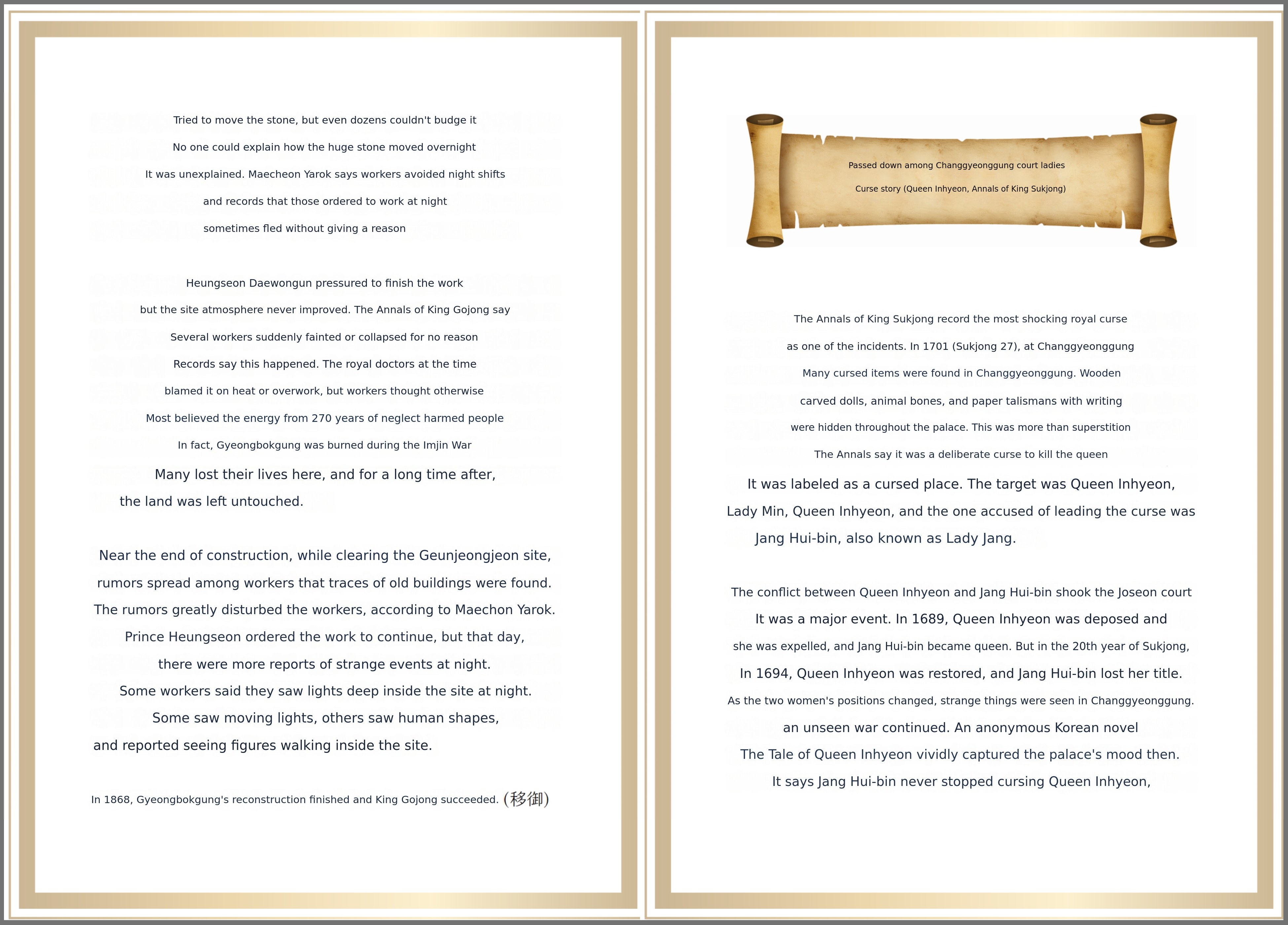
- Gyeongbokgung — Strange phenomena during reconstruction (Annals of King Gojong·Maechon Yarok)
- Changdeokgung — Sounds of weeping heard at the rear garden pond (Eouyadam)
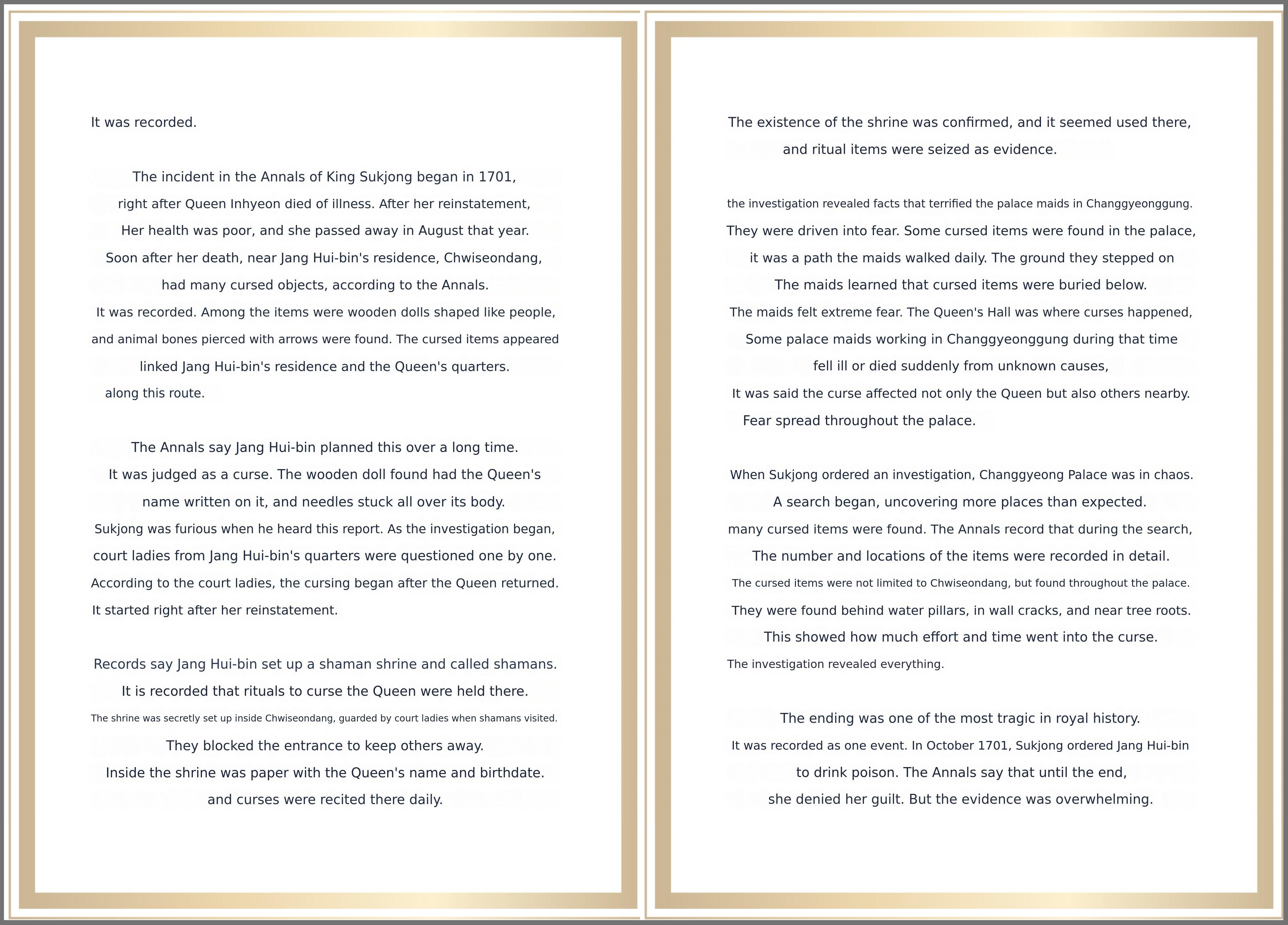
- Changgyeonggung — Cursed tales passed among court ladies (Inhyeon Wanghujeon·Annals of King Sukjong)
- Gyeonghuigung — The origin of rumors about a cursed site (Diary of King Gwanghae)
- Jongmyo — Strange phenomena witnessed by ritual officials during ancestral rites (Eouyadam·Cheonggu Yadam)
- Deoksugung — Records of strange events after the construction of the Western legation (Maechon Yarok)
- Uigeumbu — Vengeful spirit of a tortured and deceased criminal appears (Cheonyeokrok)
- Jeonokseo (Prison) — The Night Terrors Told by Prison Guards (Cheonggu Yadam)
- Hanyang Execution Ground — Records of Phosphorescence Witnessed After Executions (Eou Yadam)
- Local Government Office — Record of a Grievous Commoner's Ghost Visiting the Magistrate (Cheonggu Yadam)
- A Strange Incident Witnessed by a Wandering Official in the Provinces (Dongpaenaksong)
Chapter 2. Spaces of the Capital — Alleys, Private Homes, Villages
- Namdaemun — The Identity of the Being That Knocked at Night (Cheonggu Yadam)
- Jongno — The Parade of Goblins Witnessed by a Night Watchman (Eou Yadam)
- A Haunted House Story Passed Down in a Noble Family of Hanyang (Cheonyeok)
- Namsan — What Happened After Neglecting the Mountain Spirit Ritual (Dongpaenaksong)
- Cheonggyecheon — Rumors of the Vengeful Spirit of a Drowned Person Appearing (Cheonggu Yadam)
- Sungkyunkwan — The School Ghost Passed Down Among Scholars (Eou Yadam)
- Outside Seodaemun — Beings That Appeared Near the Execution Ground (Cheonggu Yadam)
- Conditions of a Haunted House — Common Traits of Houses Shunned by Joseon People (Ojuyeon Munjang Jeonsango)
- What Emerged from the Well — Well Ghost Stories from Across the Country (Eou Yadam)
- Calamity That Befell the Family After Moving a Grave (Cheonggu Yadam)
- Strange Events That Occurred at a Mourning House (Cheonyeok)
- People Who Entered an Abandoned House and Never Returned (Dongpaenaksong)
- Those Who Broke Taboos — Actual Case Examples (Ojuyeon Munjang Jeonsango)
- Sounds Heard from the Neighbor's House — Collective Testimonies of the Village Community (Cheonggu Yadam)
Chapter 3. Sacred Spaces — Temples, Confucian Academies, Village Shrines, Shamans
- Night at the Temple — Records of Terror Told by Monks (Eouyadam)
- Entities Witnessed at Abandoned Temples (Eouyadam·Dongpaenaksong)
- Seowon — Strange Events Experienced by Scholars Overnight (Cheongguyadam)
- Village Shrine — What Happens When the Guardian Deity Gets Angry (Eouyadam)
- Shaman's Shrine — Actual Records from Spirit Possession Rituals (Seongjong Sillok·Eouyadam)
Chapter 4. Spaces of Nature — Mountains·Passes·Forests
- Mungyeong Saejae — The True Identity of the Woman Appearing on the Mountain Pass (Cheongguyadam)
- Famous Mountains of Joseon — Stories of Deals Between Mountain Spirits and Humans (Eouyadam)
- Gyeryongsan — Strange Records of Prophecy and Fear Entwined in the Mountain (Annals Related to Jeonggamnok)
- Deep in the Mountains — The Hermit Witnessed by an Ascetic (Eouyadam)
- Nameless Passes — Collection of Ghost Stories from Mountain Passes Across Joseon (Cheongguyadam·Eouyadam·Dongpaenaksong)
- Tales from the Forest Left by Lumberjacks and Hunters (Dongpaenaksong)
- Encounters While Meditating Alone at a Mountain Hermitage (Eouyadam)
Chapter 5. Spaces of Water — Rivers·Ferries·Sea·Islands
- Hangang Ferry — Boatmen's Accounts of Water Spirits (Eouyadam)
- Hangang River — Records of the Drowned Dragging the Living (Cheongguyadam)
- The Day the River Turned Red — Strange Waterside Phenomena Recorded in the Annals of Joseon (Annals of Seonjo·Annals of Jungjong)
- Jeju Sea — Records of Sea Mysteries Told by Haenyeo (Tamraji·Tamrarok)
- Night on the Exile Island — Terrors Recorded by Those Banished to Islands (Collected Works of Joseon Exiles)
Chapter 6. Spaces of Death — Tombs·Graveyards·Boundaries
- Strange phenomena witnessed by royal tomb guards around the tombs (Annals of the Joseon Dynasty, Eou Yadam, Cheonggu Yadam).
- Bizarre incidents at the graves of noble families (Cheonggu Yadam).
- A family is ruined if a grave is placed incorrectly — Real records of geomancy ghost stories (Cheonggu Yadam).
- The corpse moved — Joseon-era corpse ghost stories (Dongpaenaksong, Eou Yadam, Cheonggu Yadam).
- A record of a person who almost got buried alive and returned alive (Eou Yadam).
- Tavern — A strange companion and a mysterious traveler (Cheonggu Yadam).
- Relay station — Nighttime road entities witnessed by couriers (Dongpaenaksong).
- Encounters on night roads — Eyewitness accounts from all over Joseon (Eou Yadam, Cheonggu Yadam).
- Entities that make people lose their way — Records of being bewitched by dokkaebi (Eou Yadam).
Epilogue. Places remember.
- Haunted places of Joseon, what remains near us today.
- Common patterns of Joseon ghost stories in historical records — Why is it always the same places?
- Reference material annotations and original source list.
Project information.
- The delivery method is the email registered on Wadiz.A Google Drive link will be provided through it.
- You can download the PDF file through the provided link.
- If you wish to receive it via a separate email, please let us know your personal email through the Maker Inquiry.
- PDF file e-book Can be used on electronic devices such as PCs and tablets.
- Murder edition. Ghost story edition. Each is expected to be 200 to 250 pages.Is expected.
Reason for choosing Wadiz
- I dedicate a significant portion of my personal time to gathering information and writing.
- With the hope that my interesting information and useful knowledge will be of some help to you, I am launching this funding on Wadiz.
- Communication with you is a great source of strength for the maker. I will always strive to be a maker who shares opinions.
Maker Introduction

- I am Mr. Plan, a solo e-book author who weaves the small stories of the world into a single book.
- My writing contains interesting information and useful knowledge about history and culture, aiming to provide readers with new perspectives and insights.
- Hoping that gentle comfort and empathy will reach your hearts, I continue to write new stories in front of my laptop today.
- Thank you sincerely for your valuable interest.